Review: Silver Nitrate by Silvia Moreno-Garcia

Rating: 5 out of 5.

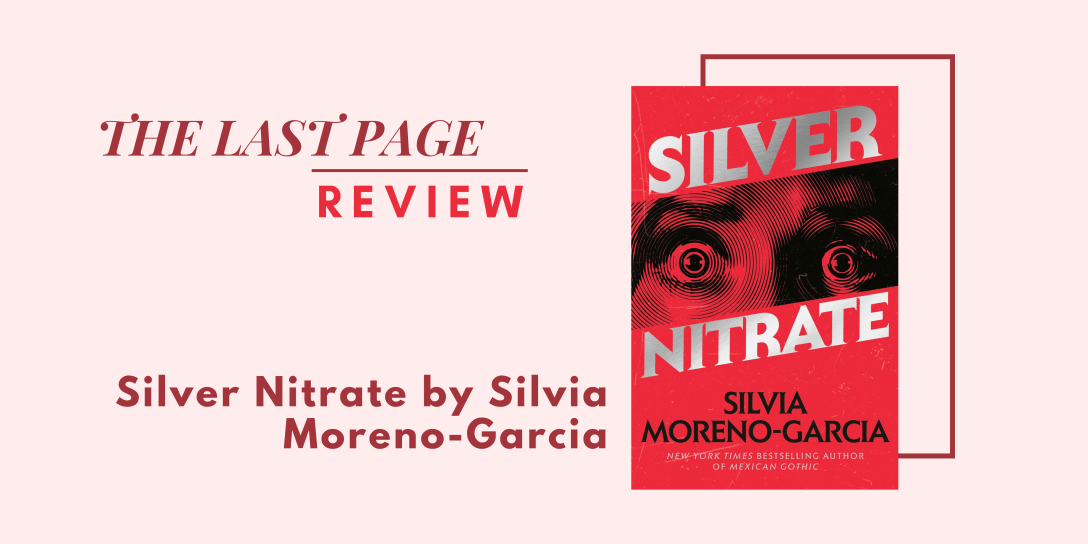
A brilliant but overlooked sound editor, Montserrat’s work behind the scenes has soured of late. Her closest friend since childhood, Tristán, is a faded soap opera star who spends his days chasing the past. When Tristán discovers that his next-door neighbor is none other than the legendary cult horror director Abel Urueta, the three form a friendship. Many years prior, Ureta was involved in a film production that was rumored to involve imbuing a kind of magic into the silver nitrate film stock, but the film was never completed. Ureta claims this is the reason his career went downhill, and he implores the pair to assist him in completing the final scene. But as Tristán and Montserrat dig deeper, they are drawn into a complicated history of Nazi occultism – a shadowed figure stalks Montserrat, and Tristán is plagued by the appearance of his deceased ex-girlfriend. The more they seek to discover the truth of the lost film, the more likely that magic and sorcery are entangled with filmmaking than they ever could have realized, and they’ll have to break the cycle to survive the consequences.

Silvia Moreno-Garcia transports readers to the silver screen with a heart-pounding thriller that subtly blends the history of cinema with a deep dive into Mexican horror and Nazi occultism. Following two childhood friends as they attempt to unravel a decades-old curse while navigating strange new powers, Moreno-Garcia slowly entangles readers in an age-old struggle with occultism and the powers vying for control. When I first read about Silvia’s newest thriller, I was more than ready to navigate curses and brave new horrors to experience a new book from one of my favorite authors. Silver Nitrate gradually drives the knife in, with a slow-building narrative that never quite makes you feel on solid ground. There is something uniquely cinematic captured here, as we are taken deep into the history of silver nitrate film and the dark magic unfortunately caught up in it. What I’ve come to love about Moreno-Garcia’s work is the historical contexts woven into every one of her stories. Silver Nitrate explores everything from Mexican horror, to movie production, and occultism, and it was all so fascinating to follow. Silvia slowly envelops readers in this world and its characters, jaded sound editor Montserrat, and her childhood friend and soap opera star Tristan, as they delve deep into the past and find unexpected horrors. Montserrat is everything I love about women horror protagonists, a jaded introvert with an unexpected cutting edge. As always, there’s a tidbit of romance present that uplifts the story and plays into the cinematic feel. With her latest, Silvia Moreno-Garcia deftly plots a sound editor’s entanglement with a fabled nitrate film that reaps unintended consequences on all those involved. Silver Nitrate has all the feels of a cult classic with a unique historical context. It’s everything I love about Silvia and her best novel yet!

Thank you to Edelweiss and the publisher for providing this arc to review.

Trigger warnings: blood, death, murder, drug abuse, racism, xenophobia

Buy a Copy:

Review: Lavender House by Lev AC Rosen

Rating: 4 out of 5.

The year is 1952, and Irene Lamontaine, head of the illustrious Lamontaine soap empire has died, leaving behind a substantial family seat vacant. Irene spearheaded the family’s soap empire to its current position with her signature and everchanging scents, held secret behind the gates of the family estate Lavender House. On the estate, the inhabitants have secrets of their own, secrets that require keeping outsiders at bay, and an understanding staff. When Evander Mills, a recently fired cop of the San Fransisco police department is contacted by a mysterious widow to investigate the circumstances surrounding her wife’s death, he finds himself behind its illusive walls for the first time. Reaching deeper into the family’s past, Andy soon finds himself beset by petty squabbles and family jealousy, but Irene’s death wasn’t an accident, and even between a family united by secrets, there are some worth killing for.

Lavender House has been aptly described as a 1950’s Knives Out mystery, surrounding a queer family, their confined existence, and the deadly secrets they keep hidden. Perfectly situated in its place in time, Rosen assembles a cloying ambiance for this novel, with an overpowering scent of deception that permeates the stuffy halls of Lavender House and unto the very page. Passing through the gates of the house aside the narrator Evander Mills, the real mystery begins once inside, as the motivations and history of each of the characters are exhumed. It was at this point of the story, that I was officially hooked. So much of what I love about the family mystery narrative is the entangled motivations and complicated relationships that are played out from start to finish. Lavender House has the added layer of the Lamontaine family being comprised entirely of queer people that have found solace, and ultimately family, with one another. For that reason, this novel is very much a stark examination of queer lives during the 1950s as it is a murder mystery. These two topics intersect as Andy investigates deeper into the family history and the establishment of their legendary soap empire. Each of the family and staff all have their own struggles with identity, which Rosen does a great job exploring in tandem with existing as queer in this time and the difficult choices necessary to exist and have any kind of security. This is a historical novel that does depict some of the violence inflicted upon the LGBTQ+ community during the time period by individuals and law enforcement, so I strongly advise checking out the content warnings before reading. I ended up having to take several breaks during certain sections of this. The existence of Lavender House in and of itself is escapist for the time period it is situated in, yet it provides an altogether intimate and refreshing inquiry into queer existence served against a stellar mystery. With its not so neatly wrapped up ending, I am hopeful that this is not the last we will be hearing from these characters going forward.

Thank you to NetGalley and the publisher for providing this arc to review.

Trigger warnings: violence, grief, homophobic slurs, homophobic violence, police brutality, animal death

Buy a Copy:

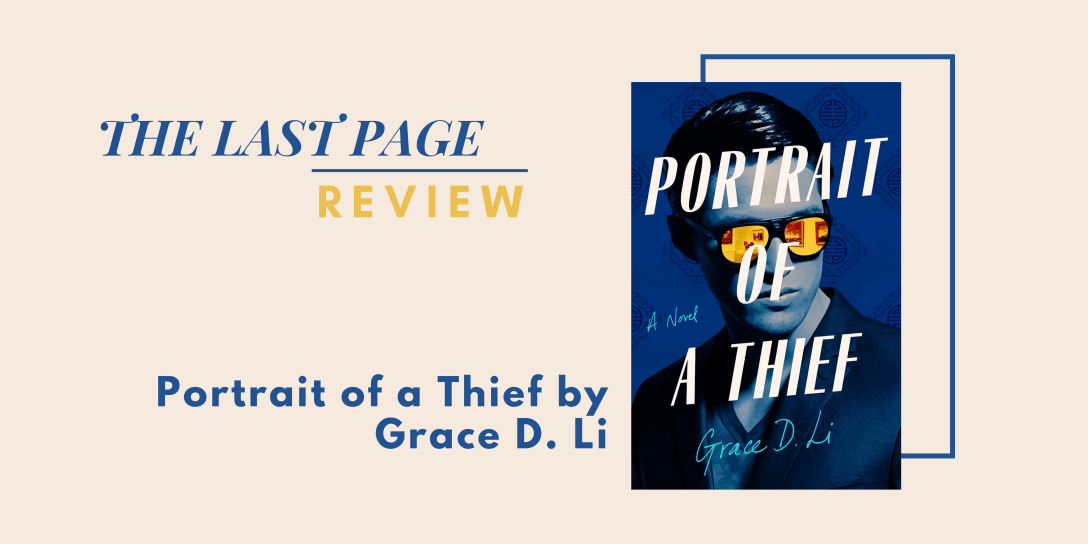
Review: Portrait of a Thief by Grace D. Li

Rating: 4 out of 5.

A mysterious art theft strikes a match when the thieves leave behind their card for Harvard Senior Will Chen, an art history student working part-time at the Sackler Museum. The perfect student, artist, and son, Will has always strived to curate every aspect of his life, yet the mask begins to slip when he finds himself entangled in an impossible plot. At the behest of his mysterious benefactor, Will becomes the leader of a grand heist to steal back five Chinese artifacts stolen from Bejing centuries ago, scattered around the world. With fifty million dollars on the line, Will assembles a crew of his closest friends, all with something to gain if they should succeed and lose should they fail. As each of the crew members wrestle with their own complicated relationship with China, the chance to take back a piece of what was stolen long ago is too great to pass up. Willing to risk it all, they may just find a missing part of themselves in the process.

Portrait of a Thief is a book that really stole the show with what it was trying to impart to its readers. Debut author Grace D. Li writes effortlessly, baring the deepest parts of her soul to all those experiencing the long-term effects of colonialism and the diaspora. Through an impossible heist with stakes beyond imagine, Li illuminates the complexity of Chinese identity against a profound yearning that lives inside those that have had to surrender a part of themselves in growing up elsewhere. With a catching comparison to Ocean’s Eleven, Portrait of a Thief brings the action up close and center, alongside an unlikely group of friends deciding to take something back for themselves. Out of all the aspects of this debut, one of the most poignant parts is the multitude of identities that are explored within. Although all of the heist members are Chinese American, their views on the mission were incredibly divided as they had all found their identity in different ways. Each of the characters had their own complex relationship with China, which was drawn out with each heist and created an interesting conflict between the group. These relationships were a stark contrast to the conversation happening around the heist and colonization, which I really appreciated as a reader. The diaspora affects all people differently, and that was really evident through the individual relationships and unique connections with China. Rather than have the crew get along, I liked that there was some conflict, both on an identity level and the heist itself. Also the little rivals to lovers storyline we were given made my heart soar. With her debut, Grace D. Li has created a novel equal parts thrilling, and critical. Portrait of a Thief examines the diverse parts of Chinese identity, diaspora, and the ways in which an identity can be in conflict, through a group of people determined to leave their mark on a flawed world.

Thank you to NetGalley and the publisher for providing this arc to review.

Trigger warnings: death, alcoholism, grief, racism

Buy a Copy:

Review: Comfort Me With Apples by Catherynne M. Valente

Rating: 4 out of 5.

The gated community of Arcadia Gardens may seem perfect, but within the confines of the neighborhood, a poisonous truth begins to fester, threatening the very serenity promised to its inhabitants. At surface level, adoring housewife Sophia couldn’t ask for a more perfect circumstance. Her life in Arcadia Gardens, her house, and her increasingly absent husband provide her with everything she could possibly imagine. Still, there are things that beg to be questioned, like the strange lock of hair decidedly not hers, or the sliver of bone expertly placed in her knife block. It seems that things might not be as splendid as they seem, and when Sophia goes digging she unearths something that could destroy her seemingly perfect life in seconds.

Comfort Me With Apples is a fantastically dark thriller that delighted and surprised me in unexpected ways. With a bit of The Yellow Wallpaper vibe interspersed throughout this strange mystery, Valente crafts a story made to be questioned at its core. A slowly decaying fruit of a novel that becomes harder and harder to ignore. While not everyone will love the twist of the knife designed, nor the lack of an accurate Gone Girl comparison, those that enjoy being unsettled will love where this novel takes them. Catherynne Valente has always excelled in her prose and Comfort Me With Apples demonstrates that clearly, with gloriously strange, and utterly imaginative language. The rules of the gated community, partnered against the actual storyline cultivates a sense of unease that preys upon the mind until right up at the end. An atmosphere that becomes increasingly more and more ominous. Where the story takes an unanticipated turn, is in the biblical elements included. These surprised me more than I thought they would, but thought they ultimately flushed out the commentary and made the reveal at the end all the more horrific. It really makes me want to go back and read the story all over again to see where the paving was laid. A lot of people have already commented on the incorrect marketing surrounding this book, and while I don’t think this was anything like Naomi Novik’s Spinning Silver, or Gillian Flynn’s Gone Girl, the domestic thriller and fantasy vibe is definitely present here. The only thing that really irked me with Comfort Me With Apples was the length. There was a lot of build-up in the first two-thirds of the novel, and then the confrontation at the end left me with so many questions that could have been avoided had time been taken to draw out the reveal. Key opinion with this one: I just wanted more. Catherynne Valente certainly knows how to write an idyllic story with otherwise sinister undertones, however, something that will be perfect for the upcoming Halloween season.

Thank you to NetGalley and the publisher for providing this arc to review.

Trigger Warnings: death, murder, gaslighting

Buy a Copy:

Review: Velvet Was the Night by Silvia Moreno-Garcia

Rating: 5 out of 5.

It’s 1971, and in Mexico City, a quiet secretary becomes embroiled in a complicated plot linked to the political unrest currently transforming the town. All Maite wants is to escape into the latest issue of Secret Romance; with every passing page, she can feel the world’s problems fade away as she is swept up in tales of passion and danger. When her beautiful next-door neighbor asks her for a favor, and then mysteriously disappears, Maite attempts to put together the pieces and finds herself drawn deeper into Leonora’s secret life and something far more insidious. Across town, someone else is tasked with tracking down Leonora, a commander of a squad created to quell political activists. Elvis wants nothing more than to leave his life behind; he cares little for the violence that comes with the job, but when he encounters Maite on his search for Leonora, he begins to envision just what that life could be. As tensions escalate on both sides, two individuals united by loneliness will have to fight with everything they have, for the chance at a future they’ve been waiting for.

Velvet Was the Night is a riveting historical crime noir that swept me up in its lush descriptions and complex characters consistent with everything else its author has written thus far. While this book is much different than Moreno-Garcia’s previous six novels, it stays true to much of what made her other works so impressionable: profound characters and her general talent for storytelling. This is a novel that draws upon the intrigue to an almost impossible point, fraying the minute hold I had on everything that was happening, and leaving me unaware of what to expect next. Among the complicated alliances and brimming hostility, Moreno-Garcia captures a profound loneliness in each of her characters, a loneliness that propels them forward even when facing dangerous circumstances. Elvis and Maite specifically, have an underlying bond that is only strengthened by the things they are experiencing. Something that added a much-needed lightheartedness to an already intense story. Utilizing dual perspectives creates a kind of split viewpoint in the novel, juxtaposed against the exterior of the Dirty War only beginning to escalate in the small period of time in which this takes place. I’m not sure what this would have looked like if it only centered around one character’s perspective, the outsider or the inside man. Both are necessary to craft the picture that Moreno-Garcia so brilliantly captures in the story. Even the connection between the two main characters is only strengthened by the existence of an alternating point of view, aiding in their respective development from start to finish. Having never read noir before, I can safely say I am planning on continuing given how much I enjoyed this. Silvia Moreno-Garcia has once again demonstrated her ability to write incredible stories in almost any genre, and I have no doubt her next project is going to be just as remarkable. Her seventh novel gives a glimpse into two lonely people living vastly different lives, and the potential they have to become something more together.

Thank you to NetGalley and the publisher for providing this arc in exchange for an honest review

Trigger warnings: guns, violence, blood, death, murder

Buy a Copy: