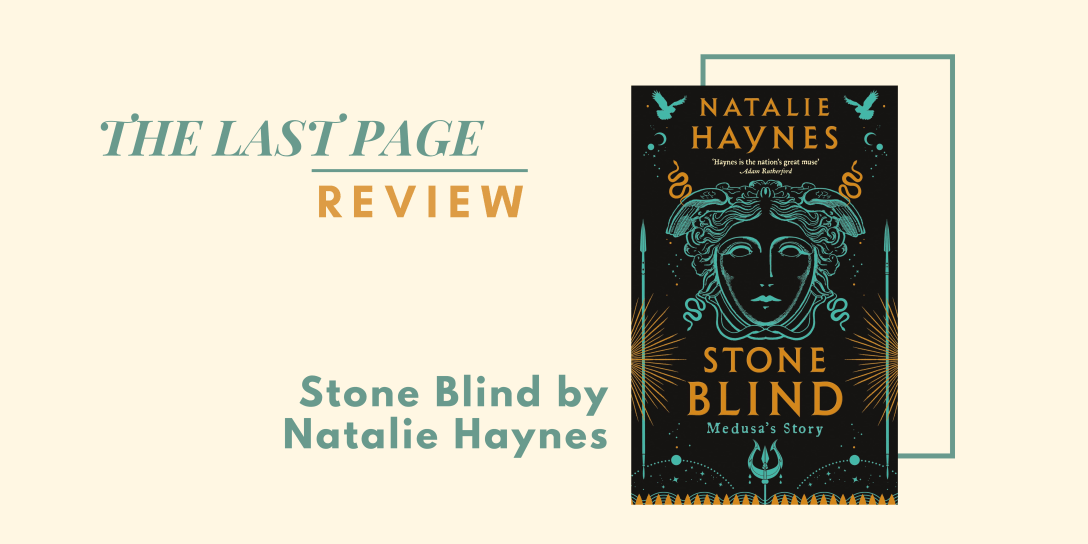
As the only mortal of the Gorgons, Medusa knows true weakness. Residing with her sisters in their windswept cave by the sea, she and the Gorgons are fully at the mercy of the whims and desires of the gods. When the sea god Poseidon enacts a violence against her in the Temple of Athene, Athene takes her revenge, transforming Medusa from a young woman into a monster. Armed with a head full of snakes and a piercing gaze that can turn any viewer to stone, Medusa becomes a proper Gorgon. Resigned to never harm a living thing, she retreats to a life of solitude, until a quest blinded by arrogance places the hero Perseus on her shores. With quests and complicated deals at play, limiting the scope of her power may be impossible when divine intervention reigns supreme and women are mere tools for the beings above.
Natalie Haynes transforms the Medusa story we’ve been fed into a layered history of the women at its center and the monster we’ve all been taught to fear. Stone Blind delivers exactly the kind of retelling I have been craving, inexplicably rich, lyrical, and wound up in tragedy. Distinctive with this one is the emphasis on the intersection of time and place, with all characters that coalesce in the Medusa myth. There is not a singular focus on the figure of Medusa, as Haynes grasps at the threads binding the story together, fashioning an elaborate tapestry that rivals that of Athene. I was pulled into the story almost immediately with Medusa’s golden childhood by the sea, completely torn asunder by the acts of violence against her by Poseidon and Athene. Like the tide returns to the sea and back again, there is a constant give and take in Haynes’s narrative, with seemingly insignificant events that take shape, strike, and then fade into the background. Every action leaves behind an echo that lingers, leaving an imprint on every event that takes place further on. There are a broad range of voices present, from godly beings to nymphs, and even animals lending their eyes to the narrative voice. With every delicate line and merciless moment, Haynes dismantles the complex relationships and powerful forces at play within the Medusa myth, creating a wholly authentic view of the monster and existing as a woman within the sphere of the gods. As the focus shifts back to Perseus, it’s clear that existing in spite of these overtly monstrous qualities can equate to a loss of agency in the wrong hands. Stone Blind is the kind of story that will forever be imprinted upon me, long after I have managed to look away from its pages. Natalie Haynes crafts a Medusa retelling that will withstand the test of time, bringing new meaning to the Medusa figure and every woman held within the confines of her myth.
Thank you to NetGalley and the publisher for providing this arc to review.
Trigger Warnings: rape, death, sexual assault, violence
 Literaryrobin