Please note this review contains spoilers for the former books in this series, The Foxglove King & The Hemlock Queen, and contains references to some of the events in this sequel.
Lore is in exile. After failing to cede her power to Apollius, the living god controlling King Bastian, she has been exiled to the Burnt Isles to atone. It is there that she fends for survival with her fellow prisoners and awaits the day she can take back her power and destroy Apollius for good. Gabe, the Priest Exalted, has fled Dellaire altogether. Alongside Lore’s parents and their fellow godly awakened, Gabe hatches a plan that would see Apollius crushed. When Lore meets an unexpected ally from her past, the two discover a way off the Burnt Isles and begin to track their way to the Golden Mount. There they must reunite all of the broken pieces of the Fount—the well of power which granted Apollius and his godly kin their immortality and godly abilities. These broken pieces are scattered across the continent who knows where, but reuniting them is the only way to destroy the divine powers and wrest control away from the gods. The closer Lore gets to the Golden Mount, the more her powers grow until she is forced to confront the role she was born into—a girl with immeasurable power destined to destroy, or one made only to be a martyr.
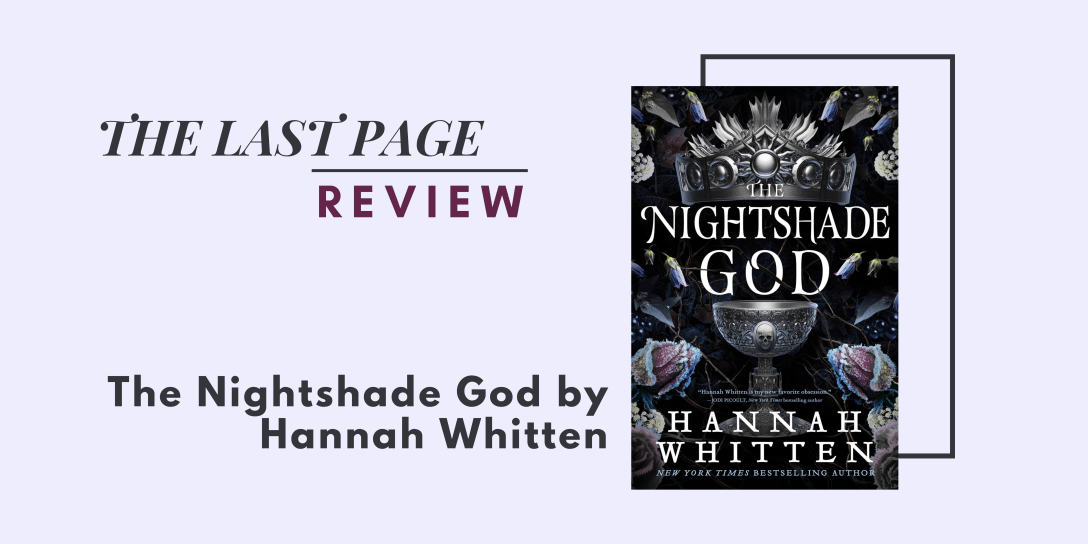
The Nightshade God concludes Hannah Whitten’s enthralling gothic dark fantasy trilogy, The Nightshade Crown which found its beginnings back with The Foxglove King. Brimming with death magic, fickle gods, and a chaotic bisexual trio—an arrogant prince, a duty bound priest, and a poison runner, embroiled in a sinister plot within the Sainted Kings court—The Nightshade Crown is a trilogy I’ve long considered as one of my favorites, perfectly poised against my more niche reading tastes. Entwining a deep expose into religion, its tendency to subjugate and the unavoidable allure of power, this conclusion sees our trio confronting the powers that have long sought to control them and their personal limitations. Lore, exiled to the Burnt Isles and cut off from her magic, Gabe lost and on the run in Caldien, and Bastian a mere puppet to a higher godly power. After two books of buildup Hannah Whitten lays bare the flawed roots of godhood, from the complexities of Auverraine’s religion to the godly beings who drank from the Fount centuries ago. This finale doesn’t let up on the relentless tension, and whatever you’re imagining for its end, prepare to be unmade in the transformative waters of the Fount upon the mountain.
Hannah Whitten returns to a world divided, as godly beings descend on Auverraine and Gabe, Lore, and Bastian are torn apart by fate and their respective ties. Returning to our trio in the midst of conflict with a god, The Nightshade God sees all three of these characters struck low. Lore fights for survival on the Burnt Isles, Gabe harnesses a fight back in Caldien, and Bastian battles for autonomy against the god taking over his body and mind. The Nightshade God is wholly different from the former two books in this series. After two books solely in Lore’s perspective, this finale pulls back to focus on other necessary perspectives. Given the nature of our characters separated across this world, Whitten bridges new points of view through Gabe, Alie, and Bastian’s fractured consciousness. The Nightshade God is perfectly designed narratively, with these split perspectives and the individual journeys of our trio making their way to the Golden Mount for the final showdown. Once again, Whitten delivers on the characters and it is this finale that draws out their startling persistence and what they are willing to give up to usher in a world free from divinity.
While I have been awaiting Bastian and Gabe’s points of view since the start of this series, The Nightshade God is the perfect moment to integrate them within the narrative. Yet, knowing where we last left these characters, it is a little heartbreaking to witness their perspectives. Gabe taking up fighting in Caldien as a way to finance his fight against Apollius and the Kirythean Empire, but also as a way to be closer to Bastian should not have hurt as much as it did. His journey out of religious subservience, shame, and fealty to Anton which was weaponized to further Anton’s sinister agenda at last reaches a solid landing place in this third and final book. Gabe really comes into his own in this finale and his devotion to Lore and Bastian was giving the longing I have long suspected was brimming beneath his stoic facade. Lore on the other hand is facing something unheard of in the loss of the power she has carried for most of her life. This third book has Lore confronting the destiny she was born into, as she grapples with her autonomy and the cost of holding fast to her power. Lore spent her life fighting for survival on Dellaire’s streets and is now granted a way to change things—a thread which all her choices hinge upon. The final act is the culmination of so many things, the journeys of our three characters together and apart, and Whitten’s examination into godhood and religion.
Hannah Whitten sharpens her themes in this finale as Lore faces down Apollius at the Golden Mount with the rest of our crew. Here Whitten unveils the depths to Auverraine’s religion, and the god who promised to usher in a new world for the faithful, but instead only wished to further his own ends. Some of my favorite portions of The Hemlock Queen were the flashbacks pre Godsfall to Apollius, Nyxara, and Hestraon’s perspectives. Rich in religious commentary and driving context to the situation that led to these individuals becoming gods, these scenes are paramount as Lore, Gabe, and Bastian return to the Golden Mount to reconstruct the Fount and drive out the gods for good. Even with these godly beings seeming so far above the meager desires of humanity, in actuality Apollius and his fellow kin are being driven by human desires. This was the final piece to the puzzle in understanding that these gods were once humans themselves and thus his promises and blessings all fed back to his selfish beginnings. That Apollius’s fear of death was his core drive was a superb reveal on Whitten’s part, fitting into balance between life and death—Spiritum and Mortem both.
Hannah Whitten’s resplendent fantasy trilogy at last finds a bittersweet end. From the final few chapters to that emotional epilogue spanning several centuries, Hannah Whitten delivers on the angst and an unconventional end to the journey initiated long ago at the Sainted Kings Court. Whitten outweighs these moments of sorrow with Lore’s unfettered determination and the tremendous love she feels for Gabe and Bastian that she refuses to let go. The Fount as its own character was an unexpected part to this final act and witnessing it go toe to toe with Lore was the perfect balance to some of the more painful revelations laid bare. I love the full circle moments we get here, as Lore takes ownership of the story and guards against humanity’s nature to take power—becoming a kind of myth herself. In this finale characters are unmade, reborn, and entire belief systems are shaken. The Nightshade God manages to paint a comprehensive picture of religious ideology, queer love, and the roles we play, be it by choice of circumstance, in a final book that is nothing short of world-altering. The Nightshade God is just perfection in my eyes and Hannah Whitten an author I trust to lead me through any kind of tale, no matter how twisted.
Thank you to Netgalley and the publisher for providing the advance review copy.
Trigger warnings: religious abuse, blood, violence, death

 Literaryrobin