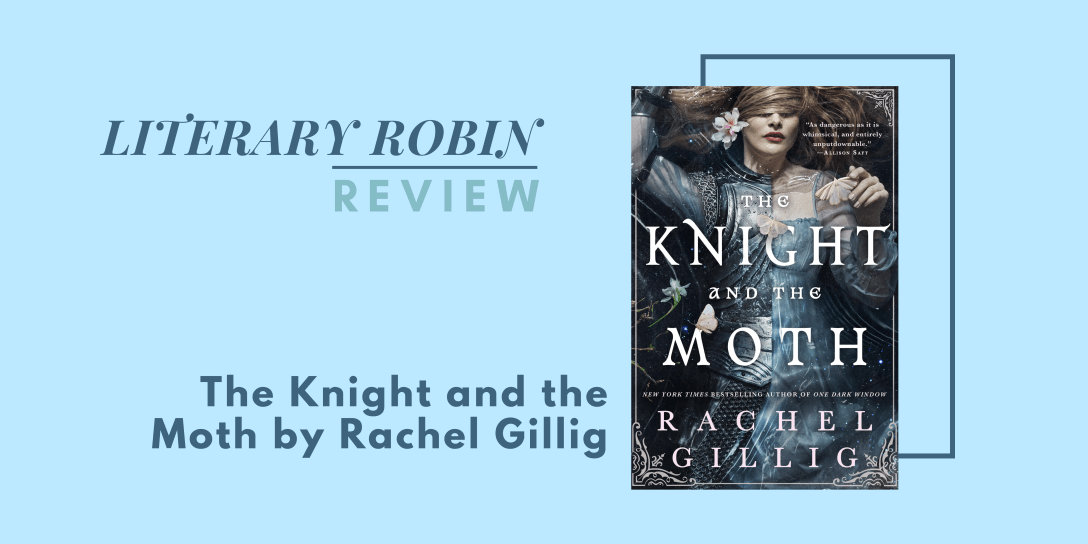
Please note this review includes references to some events contained within The Knight and the Moth. No overt spoilers but read with caution.
For ten long years all Sybil Delling has known is dreams and drowning. As a foundling child, Sybil was brought to Aisling Cathedral to take on the mantle of Diviner. In exchange for ten years of service she and six other girls were provided a home, sundering their names to forever be known by a number —gaining the ability to receive and interpret visions from six figures known as Omens. Across Traum, citizens and travelers wander the long roads to the Cathedral upon the tor to have their futures divined. Sybil and her sister Diviners are their guide through the magical waters of Aisling’s spring that drag them down into dreams. Just as Sybil and her fellow diviners close in on the end of their ten years of service, Traum’s king and his retinue of knights appear at the cathedral. Not long after, Sybil’s fellow Diviners begin to disappear one by one until only Sybil remains. Desperate for a way out, Sybil finds an ally in Roderick Myndacious, the foul and brash knight she met upon the tor at the side of the king. Entering a world unknown with a foul knight and a boy king grasping at a fantasy, Sybil will learn the cost of her divine gifts and the truth to the portents and their gods.
The Knight and the Moth is a fortifying dark gothic fairytale in which errant knights, vexing gargoyle companions, and ardent romance unite to bring truth to divination and the powers that sustain a kingdom and its divine figures. Rachel Gillig is back, enlisting her penchant for atmospheric gothic fantasy in her sophomore series, intricately carved in symbolism and unending power. There were few books I was more excited for from this upcoming year than Rachel Gillig’s sophomore novel, The Knight and the Moth. I think I let out an inhuman shriek when this showed up on my doorstep and in a self fulfilling prophecy sort of way it met all of my expectations and is easily my favorite book I’ve read this winter. The gothic is already one of my favorite genres, but add in lady knights, slow burn romance, and symbolism and The Knight and the Moth transforms into its own rare flavor of gothic fantasy. In her second series, Gillig continues to deliver on transportive fantasy that deals a devastating blow, and this is one I have yet to recover from. The Knight and the Moth is a novel altogether intricate in its inquiries into religion, but unflinching in exposing the roots of belief and the pull between religion and entire kingdoms.
Kicking off a classic quest narrative of knightly adventure with a ragtag cast of characters, The Knight and the Moth contests knightly virtues and the costs of service, whether fealty to one’s king or religious piety. Opening with the arrival of a young king and his retinue upon the tor, Gillig drowns readers in divination —from the inner workings of Aisling Cathedral to the kingdom of Traum. Sybil Delling, or “Six” is our veiled window into this enshrouded world as she breaks free from Aisling Cathedral and initiates a journey to unmake the Omens, or their gods. Coin, inkwell, oar, chime, loom stone, and moth connect to a mysterious sixth figure and provide a framing for this quest journey. Rachel Gillig skillfully places her narrative portents at various places to call forth and interpret at key moments across this novel. Almost endless in its symbolism, The Knight and the Moth is veiled in a wretched sort of beauty. The fetid water and rotting flowers around the Cathedral spring portray the violence in having to drown to divine and all of it encircles the haunting atmosphere which Gillig pulls forth.
The physical journey in The Knight and the Moth is made all the more profound through Sybil’s personal arc running alongside the quest narrative. Taken in as a child and transformed into a tool to be wielded in a power struggle she was wholly ignorant to, Sybil’s journey is both heartbreaking and fortifying in its unveiling. Something I love about reading fantasy is the slow process of learning a character’s purpose within the larger context of the story. Integrating into Sybil’s perspective it soon becomes clear just how connected she is to everything from the founding of this kingdom to the continuous cycle of making and unmaking. Sybil’s journey is one of personal enlightenment and agency, two things that were taken away from her the second she was drowned and initiated as a Diviner. Sibyl and her propensity to lose herself for a cause finds knighthood as a way to gain agency and begin to command her tale. Gillig removes the facades as soon as Sybil flees the Abbey upon the tor, but it takes much longer for her to stand in her truth and truly remove her mask.
The romance in The Knight and the Moth falls into the category of bitter banter with a healthy overdose of yearning. Picture me feral in the corner while reading this novel because Rory and Sybil had me drowned in their longing (like the wax scene? I think I died). There are few things I love more than two characters who misunderstand one another finding love. Those differing perspectives which clash and create tension slowly begin to fade away as the quest progresses. The relationship between Sybil and Rory presents an interesting dichotomy that integrates within the larger commentary on religion and fidelity. The tension between these two comes at the reality of their differing belief systems stemming from their upbringings. Rory as a foundling child given a chance and a purpose at the side of a king, and Sybil, a foundling child who was abandoned to serve the purpose of a manipulative and cruel mistress puts them thoroughly in opposition — or so you would think. But Rory plays into the knightly virtue of fealty, not to his king, but to Sybil herself. And that is why this romance had me on the floor: the longing and devotion that comes from seeing someone at their worst and the constancy of that devotion.
If there’s one thing I love in my fantasy novels it’s a funky little guy following the protagonist around. I’m proud to say Rachel Gillig understands this wholeheartedly. The sliver needed to underpin the more serious tones and overarching plot of this novel is the character of Bartholomew —the stone Gargoyle who flees the cathedral and joins the quest at Sybil’s side. Little did I know that this was actually going to lead to the most heartbreaking revelation in the last third of this novel. I should have expected nothing less from Gillig who expertly interweaves these symbols and character arcs together in a masterful final act that left me grasping at the threads and desperate for more signs. The foundations truly fall down in a penultimate scene connecting to the larger deception taking place within Traum and the woman at its center.
In The Knight and the Moth, Rachel Gillig reveals the truth to divination and the powers underpinning the faith of a kingdom. Everyone from the gods —mere humans fed on shreds of power to retain divinity— to the citizens seeking meaning upon the tor are at the mercy of one woman and the waters running free from the mountain spring. The commentary on religion as a way to keep entire civilizations beholden and subservient runs deep within this story. The disunifying portions finally find cohesion in the return to Aisling Cathedral and the confrontation with the Abbess. This final section was absolutely my favorite part of this novel as Gillig disentangles her designs and provides an encompassment for her larger commentary. It is the Abbess who claims that it is the nature of humanity to seek signs and find meaning which she, or others like her, will always be able to manipulate. The final comment that when you feed people a poison disguised as salvation they will do anything you ask was a particularly apt link within the story. As Sybil’s veil comes down and the group nears the end of their quest, Gillig connects it to the deception held by the Abbess, the portents, and their intemperate gods.
Shrouded in dreams and glimmering prose, Rachel Gillig’s The Knight and the Moth is one fantasy novel I want to stay fully immersed in. Even knowing that many readers may start this having not read Gillig’s former novels, this is a paragon to her craft and may I boldly claim —the best of her work so far. Rachel Gillig has never not brought me to my knees with her enthralling gothic atmosphere and fervent romance and I’m afraid this has unseated the Shepherd King duology as my favorite. The Knight and the Moth frames faith within a greater context of power and an unending cycle of control and rebirth. Ordinary people become gods and are forever starved for the source, but immortality is a mere tool in the hands of a greater player. In the power vacuum left in the aftermath of her concluding act, Gillig drives one last swing at her readers’ sanity. I followed some of these breadcrumbs but even I was floored in its brutality. The Knight and the Moth reveals what truth lies in heresy and the idealistic views which causes the cycle to renew. Diving into dreams, faith, and devotion, Rachel Gillig deconstructs myth in one fantasy novel which will leave you similarly transformed. Forever mourning that I have to wait even longer for the next in this series and very much missing our unconventional knight crew and endearing gargoyle companion.
Thank you to Orbit Books for providing this advance copy to review.
Trigger warnings: blood, violence, murder, death


[…] Me, Sybil, Rory, and a gargoyle named Bartholomew (a match made in heaven). In true bisexual form I am here to say my new fictional crushes are both Rory and Sybil from Rachel Gillig’s, The Knight and the Moth. Draped in divination and drowned in the fetid spring upon the tor, this gothic romantic fantasy brings new meaning to the cycle of power and religious subservience through Gillig’s two main characters Sybil Delling and Rory Myndacious. I love to see two characters at odds, especially when they are narrative foils for one another. It’s giving: you hate me because you can see yourself reflected in me, and that is rife for romantic yearning and conflict. Though we only get Sybil’s perspective across this story, I really loved following Rory, her love interest, who is on his own journey alongside hers. The devotion Rory has to Sybil is unparalleled and I promise you won’t leave this book without being completely obsessed with these two and their dynamic. Gillig had me from the moment Sybil tackled Rory (to his complete surprise). Anyway I love both of them deeply and the fact that Rory is based on one of my favorite singers, Tamino, just further proves he is worthy of half of my favorite fictional crush status. I’ll also file this under the lady knight books of 2025 for good measure. Read my review. […]
LikeLike