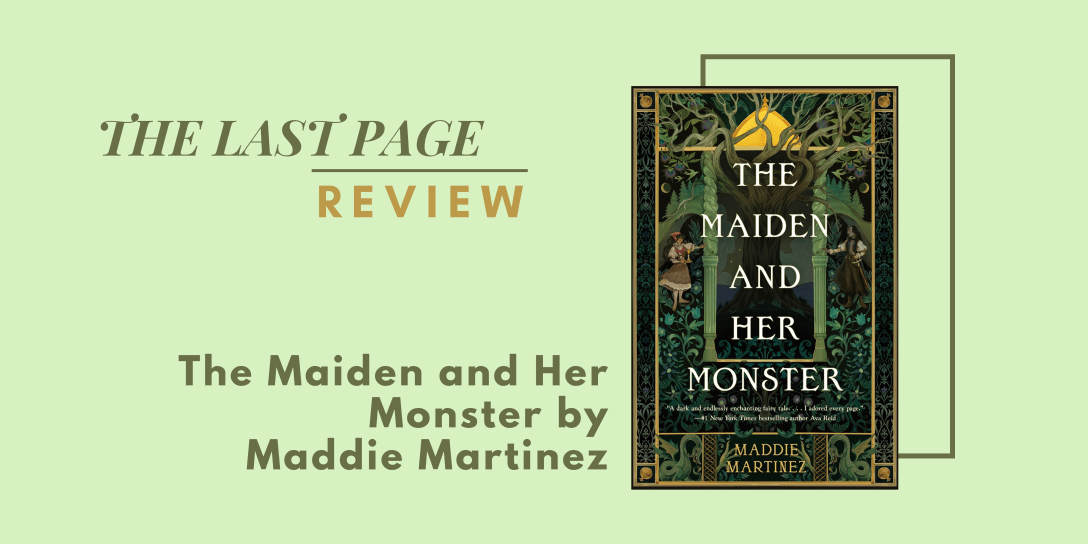
Once, the forest was good. Before it became known as Mavetéh, Into Death, the forest bordering Malka’s village of Eskravé was a place of beauty. Now five years soured, the forest devours all women who enter it. In the footsteps of these disappearances is a plague that has struck many of the villagers low. Malka is the daughter of a healer. When her mother is falsely accused of murder by a priest, Malka has the chance to prove their stories of the woods are true and save her mother from execution. All she has to do is enter the forest and bring back the Rayga, the monster itself. But when she enters the woods, Malka discovers Nimrah, a golem exiled for her crimes. Nimrah agrees to take the blame for the killings, in exchange for Malka aiding her in freeing her creator, the Maharal, a rabbi known for his teaching and practicing of Kefesh—a type of Yahadi mysticism. The Maharal is currently imprisoned and awaiting trial in the capital city Valón. To get there, Nimrah and Malka will have to engage in a bargain steeped in Kefesh, but when Nimrah and Malka make it to the capital, they find a devious plot at work within the city. Confronting it will mean facing down a world that sees one of them as a monster, and the feelings that have taken root through their flawed bargain.
In The Maiden and Her Monster, Maddie Martinez reimagines the Jewish myth of The Golem of Prague, connecting the power of folklore, memory, and faith in one transformative fantasy debut. Now I know I am not the only one that has been eagerly awaiting this novel ever since Maddie Martinez first announced it. Sapphic romance intimately connected to folklore, a monstrous forest, and romantic yearning is like Cupid’s arrow aimed directly at my heart. Martinez more than delivers with The Maiden and Her Monster, as a Yahadi healer and a monstrous Golem bargain to save their people and uncover a love they will risk everything for. The Maiden and Her Monster intricately lays bare the conflicting facets of storytelling, from those that connect a larger community and its struggles, to those built, in effect, to justify violence and oppression. Scattered across the narrative, these folktales expand upon Martinez’s inquiry into identity and the long-lasting endurance of a people. Enveloped in history and folklore, The Maiden and Her Monster hides much behind the overgrowth of one twisted forest, if one is courageous enough to venture into its gaping maw.
Encompassed in a verdant snarling prose, The Maiden and Her Monster establishes a fable-like setting through the village Eskravé and its surrounding forest Kratzka Šujana twisted into Mavetéh—a dark wood seeming to swallow women whole. The threat of this twisted forest is second only to a plague spreading throughout the village and the increasingly prevalent tithes levied against the villagers by the Ozmini Church. The presence of the church gnaws on the villagers through direct and indirect acts of violence that press one healer’s daughter to brave the forest to confront the monster within. The imagery rendered within The Maiden and Her Monster is confoundingly ineffable, yet nevertheless it remained impressed upon my mind long after the novel’s conclusion. Through these details, Martinez hinges on her novel’s core themes and the journey Malka embarks upon at its start. One such instance was in Malka’s conversation with the Maharal on the edge of the woods near Valón and the crumbling ruins of a Synagogue. This portion of the novel was particularly memorable, as the memory of the shul Amichati is made present through Kefesh and the resilience of the Yahad made all the more tangible. The language, the imagery, the story retold, all illustrate the perseverance of this community and their call to rebuild again and again.
The characters Martinez molds into being were my favorite part of The Maiden and Her Monster. The juxtaposition of Nimrah, a golem assembled from river stones to protect the Yahad in Valón, and Malka, a devout Yahad and daughter to a healer was the perfect center of conflict for this story. Faith is as easy as breathing for Malka, and her connection to Kefesh as an extent to her faith and relationship to Yohev was incredibly profound. Maddie Martinez ties the mysticism of Kefesh to various folktales created to caution and warn against its practice, and conversely the autonomy gained through such knowledge. Nimrah’s arc on the other hand, is a bit more tricky. Faith to her is an essential part of why she exists—as a protector to the Yahad, but it confines and leaves her little room to forge her own path, to have unique desires, or make connections to belief unconstructed. Nimrah confronting these limitations and her core drive to protect is as liberating as the Yahad standing strong against their oppressors in Valón. Martinez bridges this with an intense query into the monstrous—are individuals only the sum of their parts and monstrous by design, or is it more deliberate—an intentional choice.
The Maiden and Her Monster is a novel entirely concerned with story, from the tales that further nationalistic agenda and rhetoric, to the ones that confine and free all in a single breath. Maddie Martinez unveils unique interpretations within their telling, which can mean the difference between a cautionary tale, the revising of key histories, or the endurance of a community. I love the story within a story style narratives, and the patchwork narratives that connect folktales against the larger backdrop of a quest journey. The Maiden and Her Monster starts by constructing a typical quest narrative that is irrevocably, and necessarily sundered by Martinez as Malka and Nimrah arrive at a city teetering on the edge of something. The stories themselves hold tremendous weight, to empower, warn, or justify, and at the core of Maiden is an interrogation into all of these facets. Adding in the history of the Yahadi people and the political landscape within Ordobav, everything within The Maiden and Her Monster is thoughtfully placed and works in tandem as a living, breathing thing—much like stories themselves.
Trekking through an evil forest responsible for killing dozens of women while falling in love with the monster within is merely the enticing surface to Maddie Martinez’s debut fantasy novel. But like the dense and twisted forest Mavetéh, Martinez’s debut hides much within the background and the only way to uncover it is to brave the forest, and the monsters, within. Through Malka, a young woman desperate to slay the monster and return to a semblance of normalcy, Martinez illustrates a community’s pain as a representation of more deliberate, systemic injustices, than a singular evil that can be defeated with just one blow. A work long endeavored, but no less important in undertaking as this novel draws to a close. The Maiden and Her Monster sees stories take on a life of their own, becoming the extent of a people and the complex tapestry of history reinterpreted and retold. A Jewish fantasy novel abundant in history, politics, and faith, The Maiden and Her Monster is exactly the kind of story that will endure long after its initial telling. Maddie Martinez is the kind of talent that doesn’t come around often, and I am overwhelmingly feral for anything she writes next.
Thank you to Tor Books for providing me an advance review copy.
Trigger warnings: death, violence, blood, murder, gore, torture, xenophobia, antisemitism, sexism, misogyny

 Literaryrobin