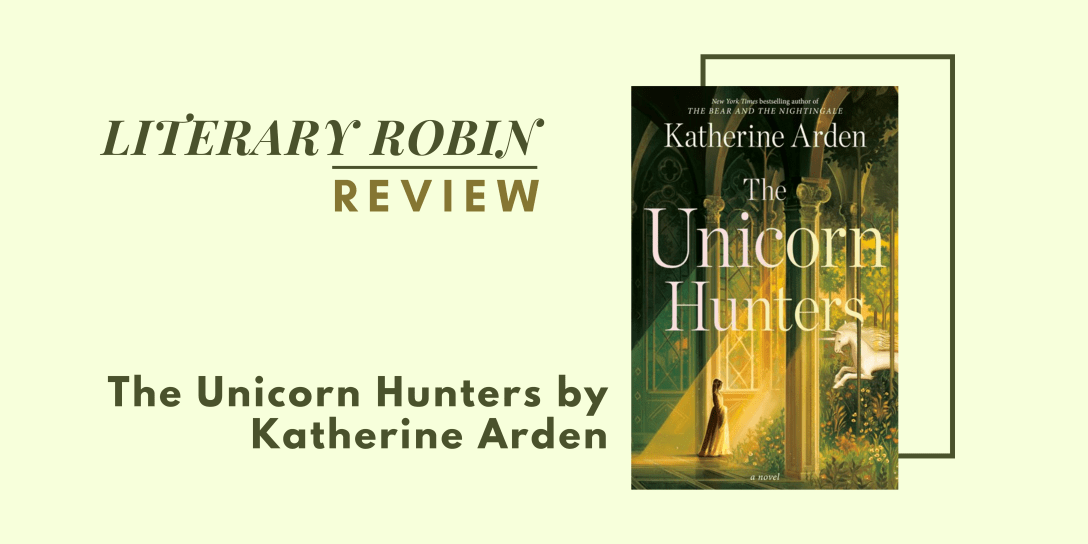
Review: The Unicorn Hunters by Katherine Arden

Rating: 4.5 out of 5.

Anne of Brittany has long dreaded her marriage. Since the invasion of France spelled the death of her father, she has accepted the life of a duchess with grace, knowing full well her lands and her body will not remain hers for long. France means to marry her to their king to secure Brittany, but in secret Anne plots an alliance to Maximilien of Austria, the king’s greatest rival. Secrets are not long harbored, not when every court has diviners to glean information from the opposition. Anne’s only saving grace is the forest of Brocéliande, a wood long thought to be enchanted which could offer protection from prying eyes. Desperate and willing to lie to secure her future, Anne presents a ploy: they will tell France they hope to hunt a unicorn. Something which requires Anne to be unmarried. While on the hunt she will wed Maximilien by proxy and none will be the wiser. When the hunt reveals a real unicorn and a stranger returned out of time, Anne soon comes to know magic is real, but as her ploy has been successful it is of little consequence. Lies begin to have a cost and as Anne grapples to control the narrative against a power hungry France, hiding the truth to magic becomes impossible. For magic is real, and it wants her. 

In The Unicorn Hunters, historical meets the fantastical with France on the edge of obtaining Brittany and the magical forest of Brocéliande bringing magic and memory to the verge. Katherine Arden goes beyond the expected in her latest novel to show how the best parts of fantasy include history retold. Through her focus on Anne of Brittany, a woman placed into a singular narrative, Arden recontextualizes the life of the duchess, one where her cleverness finds resonance in the magic of a lost city and a forest of secrets. Most importantly, unicorns. There are unicorns. An elaborate lie built to retain control of Brittany leads to magic taking root within its borders, where portents, diviners, and courtly intrigue are at their height and vying for dominance. Swept away in a hunt for a unicorn and a lost world impressing itself upon a duchess, The Unicorn Hunters appeals to a magic just out of reach, but one that can be shaken out of sheer tenacity. Cunning women, delightful animal companions, and a strange otherworld all find a place within the confines of this audacious historical legend. The Unicorn Hunters is proof that Katherine Arden can do no wrong with her penchant for sweeping historical fantasy. That we need to have her spin on every kind of fairytale—and history for that matter. 

Katherine Arden’s hold on history and memory crafts an extraordinary saga of a duchess’s quest to obtain freedom, for herself and for her kingdom. A saga that intersects an age old magic within a forest and forces beyond her greatest imaginings. The Unicorn Hunters threads an enlightening tapestry on fifteenth century Brittany down to the minutiae, even as Arden takes readers on a fantastical journey complete with sea-drakes and the iconic mythical figure of the unicorn. The Unicorn Hunters features some of my favorite writing from Arden. Think the atmospheric feel of the Winternight trilogy transplanted into the forests of Brocéliande during a period of turmoil. Katherine Arden frames an essential query here, a driving force for her to build out her tale. The Unicorn Hunters asks, if we aren’t first granted power can we access it by other means and thus change our fate? All that is central to the life of Anne of Brittany—duchess yes—but one relegated to a single fate: marriage and children in service of France. Breaking free spirals into a classic fairytale: the girl who catches the attention of the forces of magic. Not so typical, a quest to find the drowned city of Keris. A Katherine Arden novel would not be complete without persnickety family members, adopted children, and a delightful animal companion (named Butter no less). This story is wholly her own and yet something I’ve never seen from her before.

The Unicorn Hunters is another fabulous historical fantasy novel from one of my favorite writers within this space. Something quintessentially Katherine Arden in tone and humor, but new for its breadth of history. The Unicorn Hunters had me thrumming on the sheer possibility wound up within this distinct era. The fantastical feel of this novel does not just hinge on the unicorns and magic of it all, but on the time period itself. Beliefs and customs long past through which people dictated their entire lives are brought to life once more and they carry a weight that Arden uses to further her narrative. The place for women, land, and power are all grounding cornerstones within The Unicorn Hunters that provide an additional context and conflict. Yet for all of this it is really the characters who shape this story into pure magic. For Arden each perspective is rich and laden with details one cannot help but gorge themselves upon. Where history comes to life and the magic takes root. Here for Anne of Brittany’s elaborate web of lies. She should have more of them actually (as a treat). The Unicorn Hunters is history respun into legend. Where myths are made real and clever women take their rightful place at the forefront of such tales. Unicorns and devoted men kneeling at their feet.

Thank you to Edelweiss and the publisher for providing the advance review copy.
Preorder a copy — Out June 2nd

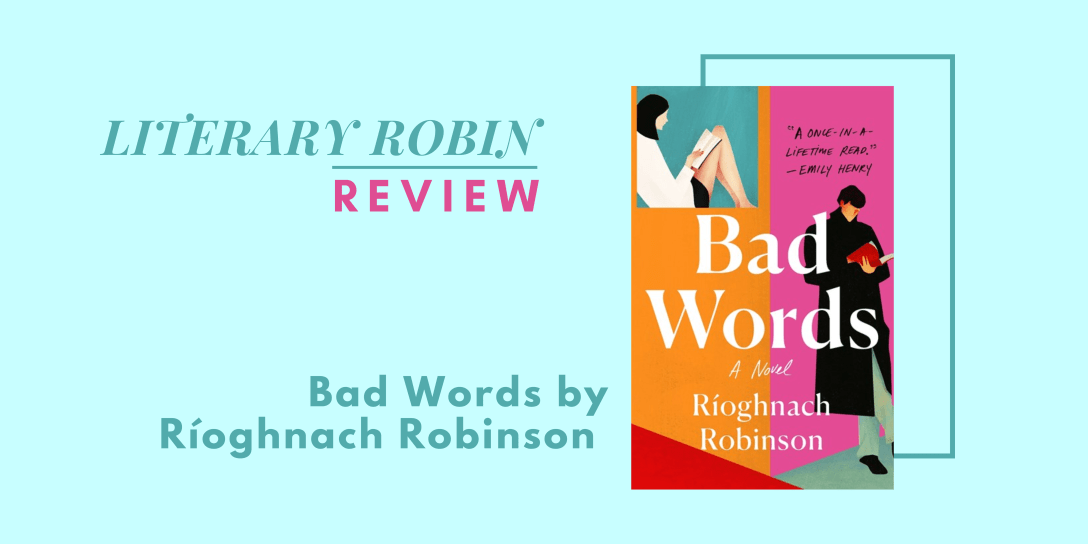
Review: Bad Words by Ríoghnach Robinson

Rating: 5 out of 5.

Author Parker Navarro’s debut novel was supposed to be a success. The advance: more than staggering, with early reviews slating it as the book of the year. All castles must crumble and Parker’s fell at the hands of notorious book critic, Selina Chan, who panned his book, dubbing it a “stupefying misfire”. Superseded by more negative reviews and online vitriol, his debut was in its own category of failure. Four years after the flop that was his first novel, Parker hopes to claw himself out of the pit when who should publish a review but the woman who buried him in the first place. Selina Chan would rather have not been tasked with reviewing Parker’s sophomore novel, but declining funds and readership at City Magazine necessitate she do her job by any and all avenues. So it’s just her luck that the author in question approaches her at an industry party and they get into a scathing argument—one that is filmed without their knowledge. Their feud gone viral, Selina and Parker navigate new scrutiny in a landscape that seems to benefit them: Parker with increased preorders of his upcoming novel and Selina with magazine viewership. Neither wants to back down, not with their entire futures on the line. Yet as Parker and Selina clash, they soon realize no one understands you quite like an enemy, and that animosity is masking the mirror they hold to one another. Moving forward means stepping back from who they are to everyone else, but letting go is harder when you have to admit you were wrong.

Bad Words is the romance novel of all time. A startling look at why we create, critique, and the tenuous publishing landscape, all through the perspectives of a feuding author and book critic. It’s a book that knows the power on the page, the page itself a series of deliberate choices and writing a tremendously public act. All of that is a testament to author Ríoghnach Robinson who unfolds her public feud between novelist Parker and critic Selina, one that prompts a path towards change and unforeseen connection. With their impassioned back and forth—each convinced they are right—a romance first appears out of the question, if not for a kernel of familiarity uncovered after every heated argument. Like the love they share for an obscure novel from their teen years or a favorite, slightly pretentious drink they both order. Bad Words had me waiting on bated breath for Selina and Parker’s next exchange, to fight or to give in to the intense connection at the heart of all of their interactions. But like any true enemies to lovers, these two have to wade through the issues that led up to their quarrel. Bad Words finds its place in the literary landscape, challenging our views on criticism in the book space and interrogating the essential question: why do we create and how do we connect? Bad Words is as bracing as opening ourselves up to criticism can be, where to be known is to be seen for the totality of who we are.

When I first settled in to read Bad Words, there was a moment when I knew I was in the presence of greatness—that I was reading the kind of book that is both rare as it is vital. Ríoghnach Robinson’s debut is an eye opening work of fiction that presents the kind of questions and conversations this industry has long been grappling with, inside and out. Robinson sharpens up a commentary on the necessity of criticism within the book space, authenticity at the heart of writing, and the myriad of ways we reach out to connect with others, with writing as the spark. Not complete without a romance, Bad Words feels both a homage to the rom-coms of the early 2000’s and a subtle nod to our lord and savior Jane Austen. Robinson writes for the readers who want a modern romance with all the heart, complexity, and intense character work comprised in an Austen novel. That and a contemporary enemies to lovers story (which I have long thought impossible but revoke in the wake of this novel). Bad Words has the feel of a true enemies to lovers tale, but make it literary, with real stakes to uphold the enemies of it all. For who is not your enemy if not the woman responsible for ruining the success of your debut novel? This story is all Ríoghnach Robinson, who grounds it ever deeper with attention paid to authorial intent, mental health, familial relationships, and online spaces, all while rounding out a seemingly impossible romantic arc between writer and critic.  

The star of the show in this romance is of course our writers, Selina and Parker: two not so different people yearning to connect with writing and each other. Criticism is the tinder that sparks the flame in Bad Words prompting a feud and a deeper look at authorial intent, journalistic integrity, and literary criticism entirely. There is an intimacy that comes with knowing someone’s writing down to their core and to be bold enough to tell them exactly how it comes across. Which is exactly what Selina asks of Parker as she enters into public conversation around his sophomore novel, High and Dry. Selina and Parker’s improbable romance emerges amidst in person fighting matches, cross conversations on social media, and a self insert short story about the critic you currently hate (yikes I know). The intimate tether between love and hatred is actually a thin line, which they fight every time they interact in public while falling ever deeper in private. Both Selina and Parker are hiding through their writing. Parker writing for everyone else and not himself, and Selina using writing as a tool to construct a fortress around herself. Love for these two characters is tied up in the criticism: in letting each other acknowledge their flaws. An essential component to living and loving with authenticity.

Part of what makes the romance between Selina and Parker so addictive is how opposed they are. Robinson spends the length of Bad Words slowly breaking down these barriers and drawing them closer together as they realize: you are me and I am you. Despite the separation in their roles in publishing, writer and critic respectively, both feel the tremendous weight of expectations and the public facing nature that comes alongside pursuing their careers. Intersecting online publications, snippets from social media, and Parker and Selina’s own writing, Robinson begins to contextualize the fraught modern publishing landscape. One that is all too quick to latch on to a feud and stretch it for miles, and take controversy and spin it for personal gain. Everything from publishers, journalists, former friends, and industry names, all want a bite out of the Parker x Selina feud. There is truly so much to dissect even on this front, but the added familial relationships bring more to Parker and Selina’s interiority. For Parker his failures weigh against his desire to support his family. All the while Selina protects her castle, defending a life that went against her parents wishes. Bad Words could not be any better with this rich subject matter, but it rounds out a third act with a discussion over depiction versus endorsement in fiction—this topic a catalyst for conflict and eventually reconciliation between these literary enemies. 

Ríoghnach Robinson’s romance between an author and his least favorite critic manages to deliver the romance of the year and it’s not even out until fall. Bad Words is pure brilliance in book form, an emotionally rich love story that’s challenging, perceptive, and best of all clever. Framed within the publishing industry and the modern literary landscape, Robinson crafts an insightful romance concerned with all things writing to get to the heart of why we create. Parker and Selina are the epicenter of this, bearing the weight of the industry on their careers and identities. Separated by the boundaries of criticism and a viral feud, their romance is almost too far-fetched which is why it feels earned by the time these obstacles are circumvented. Parker was never more right than he was in falling for the woman who read him down to the marrow and challenged him to write authentically. I support women’s wrongs (in fact there are none here), but Selina Chan I would wage battles on your behalf (and win). Bad Words perfectly lands its quest for connection, something we cannot gain without first being honest about who we are. Thus we come back to critique, which shapes literature and is an essential part of the literary ecosystem. As a lover of themes and interrogating topics at length, Bad Words left me pensive, reflecting far beyond the end of its pages. Bad Words is a book for book people. Whether familiar with the industry or not, prepare to be lost in its marvelous depths and come back yearning for more from Ríoghnach Robinson and a literary nemesis to call your own. 

Thank you to Edelweiss and the publisher for providing me with an advance review copy.

Trigger warnings: past suicidal ideation (discussed), racism

Preorder a Copy – Out 6th October

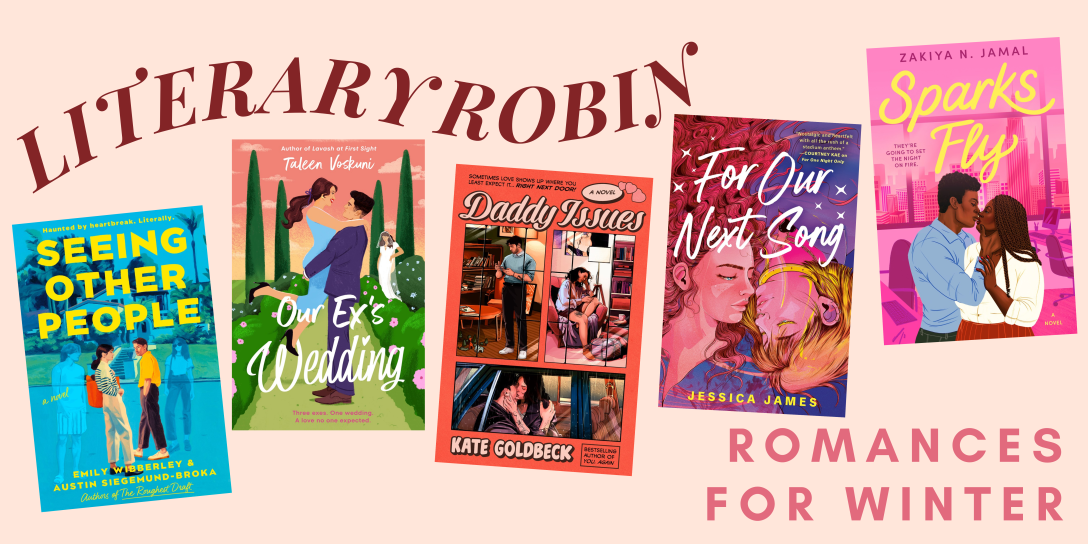
Let’s Talk: Romances For Winter

Yippee Ki-yay romance lovers. It’s the best time of year for romance with that winter chill keeping us all cozy inside (storms included). Cozying up with romance is the way to survive the winter and I wouldn’t have it be any different. This next crop of romance recommendations was absolutely meant to be shared around the holidays but with work getting busy my writing slowed down a ton. Fitting since now I can count this as my first quarter romance picks ahead of the Valentine’s Day holiday.! This was an excellent quarter of romance reads as I read everything from ghosts to sports romance. Tis the season as it were. Yet I stayed true to my roots with second chance romance and yearning—which I will never abandon. Lot’s of sophomore novels and debuts leading out the beginning of the year. Sink in and enjoy!

Disclosure: I will be linking my Bookshop affiliate link below my reviews. I earn a small commission if you purchase books through this link and it is one way to support my reviewing! My affiliate link will simply be labeled “Bookshop.”

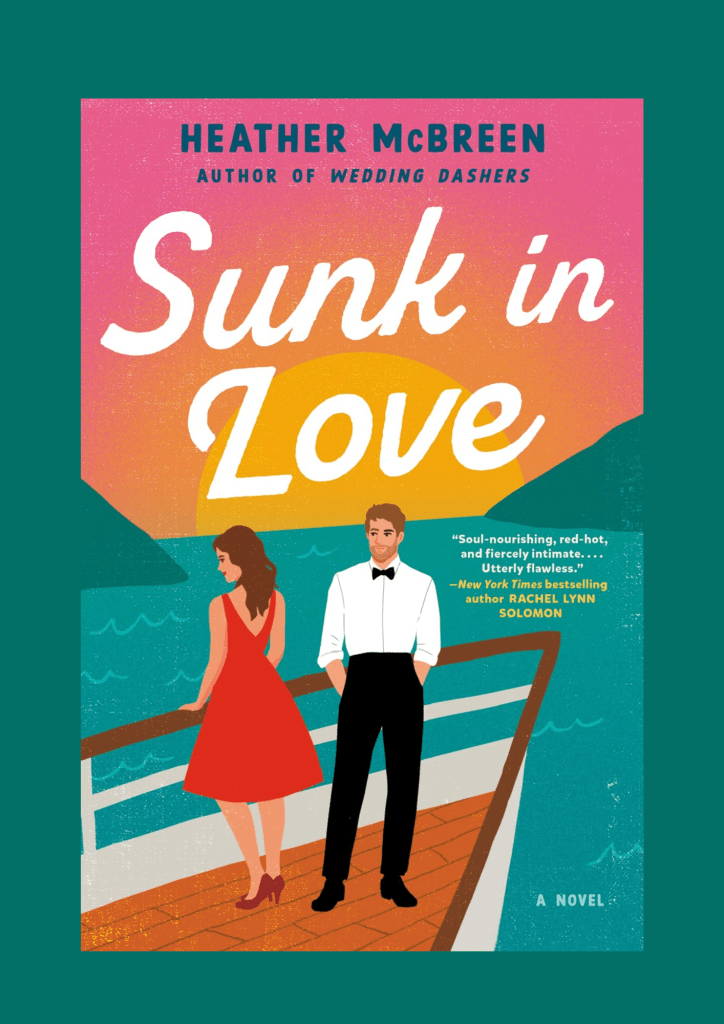
Sunk in Love by Heather McBreen

Second chance romance while on vacation in Hawaii: hot. Being stuck on a cruise ship with your entire family: not. Two spouses veering towards divorce must pretend they’re still in love on a final family vacation—rather than let their family in on the truth and ruin their last trip together. Roslyn and Liam are a sworn pair. Together so long one could not think of one without the other. When a tragedy occurs, they face a reality where they aren’t or rather cannot be what each other needs. After months of avoidance and silence lead to a three month separation and encroaching divorce, they face telling Roslyn’s family. Both would rather push through the upcoming vacation than reveal the truth. But vacationing away from their lives is more difficult than they thought as Roslyn and Liam must question not is the love still there, but is it ever really over. Sunk in Love, Heather McBreen’s sophomore novel is an achingly heartfelt second chance romance set alongside a scenic Hawaiian cruise. I make it no secret that second chance romance is my favorite romance trope. The possibilities are limitless and the angst even more so. Sunk in Love is another one to add to a growing list of flawless second chance stories. Tracking a present and past narrative between Liam and Roslyn as love is discovered, lost, and regained, McBreen charts the ups and downs of a family vacation and a love story all in one. McBreen understands the inherent hotness of the British accent, someone making you lasagna from scratch (on a first date no less), and a man who reads romance novels (I know). This is a gorgeous gorgeous second chance love story for the cautious hopeless romantics, yearners, and lovers of stoic men. Sunk in Love is proof you can have it all.

Buy a Copy:

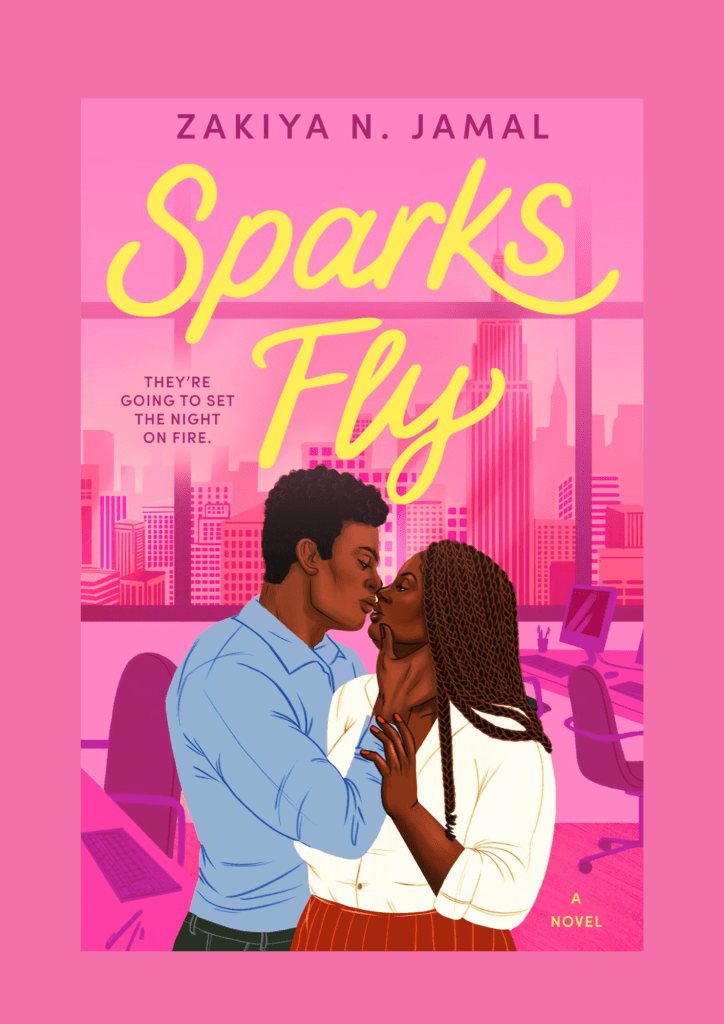
Sparks Fly by Zakiya N. Jamal

Tired of waiting around for life to find her, twenty-seven year old journalist Stella Renee Johnson decides to seize it with two hands—literally. An invite to NYC’s hottest club and an unshakable determination, Stella quickly comes face to face with a handsome stranger and just as quickly flees their steamy assignation. At work the next day the last person she expects to see is the stranger from the party. That handsome stranger is Max Williams, the brother to their CEO—a CEO who is currently ramping up a partnership integrating AI into their writing. With the chemistry already sparked, Stella and Max can’t seem to pull themselves away from each other even as professional ties suggest they should. Even more, they may not want to. A romance for the late bloomers and the bisexuals. That’s what Zakiya N. Jamal brings to the scene with her perfectly modern love story, Sparks Fly. Sizzling chemistry initiates a romance between unlikely duo, Stella and Max as they navigate workplace and personal conflict alongside their blossoming relationship. This is a romance that starts out with the heat on high and dials it back as our leads face whether or not their chemistry can outlast the everyday. Like your boss forcing you to use Generative AI in your writing process putting your career on the line. Despite the various ups and downs, Stella and Max never make you doubt their incredible connection. It’s there, they just have to fight for it. Jamal builds up a flawless romance while interrogating artificial intelligence in the workplace, fraught friendships, and complicated familial dynamics. Sparks Fly is a whip smart contemporary romance that not only made me feel the sparks but the power in building your future step by step.

Buy a Copy:

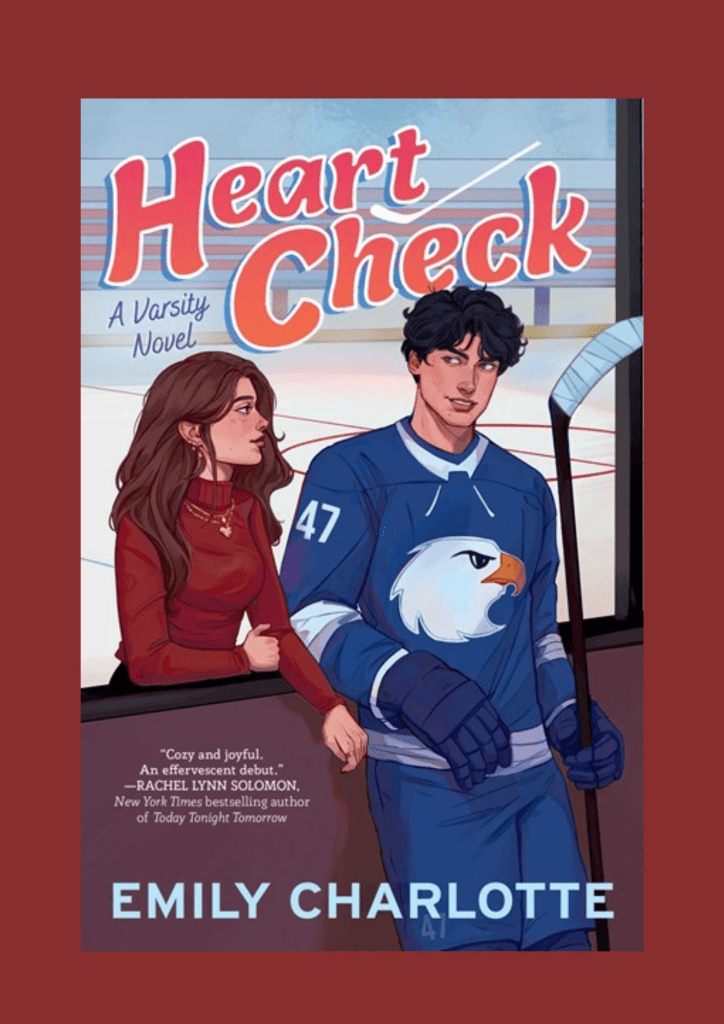
Heart Check by Emily Charlotte

Luke Dawson and Harper Braedon have always been at odds. He’s the town’s hockey darling and she is decidedly not, making a name for herself in handcrafted jewelry and hating on the beloved sport. But the two are stuck working together in the local diner after school, sharing classes, and navigating the ins and outs of their small town. Ahead of an opportunity for a young entrepreneurs grant, their school’s hockey coach is fired for embezzlement and Dawson is partially responsible for starting a rumor that Harper spilled the beans. Now the grant is a no go, and Harper and Dawson are forced into the close proximity they have spent years avoiding—to build something better or be stuck forever on opposing sides. Venture into Hamilton Lakes in Emily Charlotte’s delightful young adult romance Heart Check, a small town coming of age story involving the misperceptions of the heart and all of the quirks in leaving animosity behind for uncertain ground. It has been awhile since I have been so utterly charmed by a story such as this one and lord was I charmed!! Heart Check reeled me in with the hate to love premise and left me feeling empowered and entirely heart-warmed by its end. This novel hits the perfect shot with hilarity (see Dawson having Troy Bolton level anxiety crashouts and Harper losing it over a crush because he signaled before turning (a green flag)) and deep emotion. Exactly what you’d expect of the turbulent high school years. Heart Check is absolutely a romance, but it’s also about two opposites breaking down social barriers to reach mutual understanding—challenging predisposed beliefs and building to something better. Readers won’t just find comfort in the small town wintery-scape of Hamilton Lakes or the romance Charlotte has crafted, but the strength embedded in this community.

Buy a Copy:

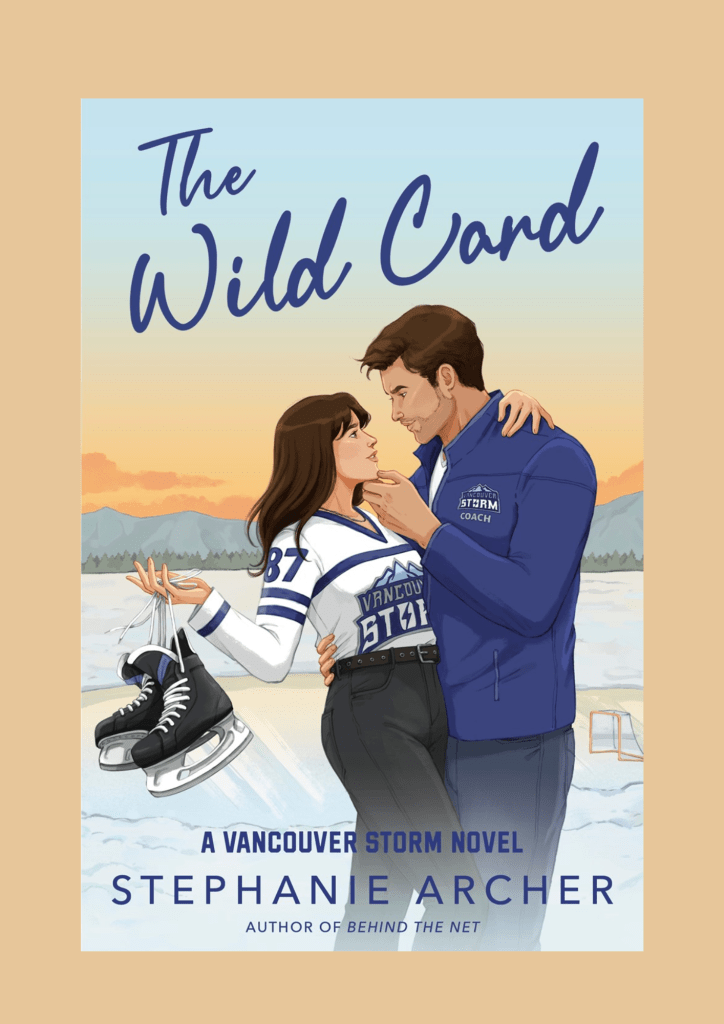
The Wild Card by Stephanie Archer

The entire Vancouver Storm team and one feral alley cat: Jordan you need to be with Tate. Jordan Hathaway’s safe space is the Filthy Flamingo, the bar she manages in Vancouver and home away from home for the local hockey team. Behind the bar she can avoid her past failures and the fraught relationship with her father, the owner of the Vancouver Storms team. Breaking that peace is Tate Ward, Vancouver Storm’s coach stuck checking in on Jordan every now and again despite the fact that they cannot stand one another. When her father announces his plans to sell the team Jordan is thrust into the orbit of hockey, her second love and the thing her father chose over family time and time again. A defining choice: to take over the team or let it extinguish right as it is on the brink of making history—something Tate is not willing to let Jordan decide alone. The Wild Card is a hockey romance to end all hockey romances. Seamlessly a hard hitting look at the lives we lead for others and the power that comes from opening ourselves up to authentic connection, it’s a romance fueled by misunderstanding, coffee runs, clothing mishaps, and forgiveness. I’m always going to crave a true hate to love story where we get to crack open the interiority of our characters and pour over the details. Wild Card doesn’t rush headlong into the romance, instead opting to establish our two leads and the issues they have to surmount—earning every single one of its almost five hundred pages. Tate and Jordan are two feral cats at a standoff (which is why it’s even funnier they get roped into coparenting a stray cat together). The Wild Card expertly contrasts the bitterness and grief packaged into a chaotic five foot tall bartender, and a stoic controlled hockey coach trying to hold it all together. Sharp, steamy, and brimming with delicious tension, The Wild Card is not just the best Vancouver Storm novel, it belongs in the hockey romance hall of fame.

Preorder a Copy — Out 3rd February

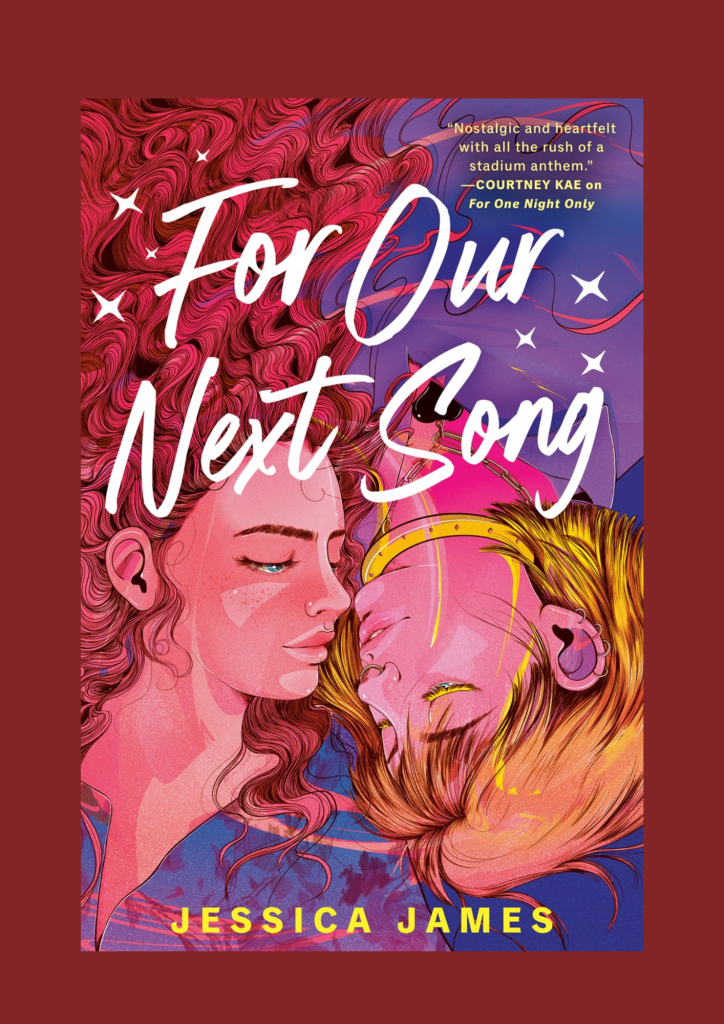
For Our Next Song by Jessica James

What’s next for your rock band is nothing compared to unresolved feelings for your bandmate. Keyboardist Jane and drummer Keeley have always had a perfect harmony on stage. Off it they are desperate to hide their feelings by a tried and true staple: avoidance. When a chance for collaboration forces both women into close proximity, decades of feeling and attraction come pouring out in the music and the space between them. A forever kind of connection may be in the cards, that is if they can navigate a much larger test through the media and their respective families. Jessica James returns to her acclaimed recently reunited punk pop group the Glitter Bats in For Our Next Song, a sapphic friends to lovers romance all about composing music and the importance in living our authentic truth. A reunited rock group on the brink of a major resurgence is merely the beginning of this romance and much like their comeback it’s only better from there. For Our Next Song is the rock filled sapphic romance we deserve, striking the perfect chord between angsty and romantic like all the best sort of love songs. This her second in the Glitter Bats series, Jessica James strives to connect the history of a band both past and present, a slow burn sapphic romance, breaking away from religious trauma, and the fragility of the media, all of which are executed to perfection. James doesn’t just make you feel for her main characters; she makes you fall in love with the landscape surrounding them—be they writers, fans, industry names, or fellow bandmates. It made me wish I could really kick back to the Glitter Bats and throw support behind these two women (or force them to confront feelings from within the band). Jane and Keeley need that push and the result is electric and heartfelt, a love story well worth cheering on from the crowd or behind the stage.

Buy a Copy:

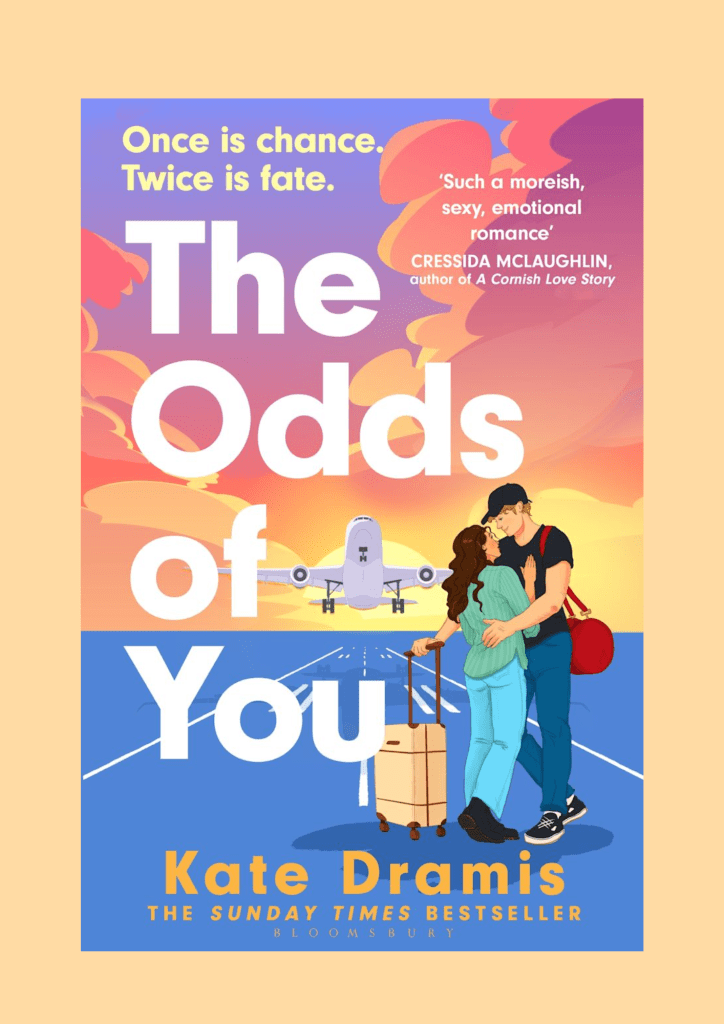
The Odds of You by Kate Dramis

Writer Sage Collins already did the hard thing and bet on herself, quitting her day job after the success of her dystopian series debut. But the hard thing is actually writing its direct sequel, of which Sage has written practically nothing. On a flight to Comic Con Sage is tested further with an overly curious passenger, Theo, who could have been created in a lab just to irritate her. Theo is also a rising star, but instead of books he has made a name for himself in film. After their strange encounter is captured on camera at the airport, rumors spark of a romance between them and squashing them leaves Sage even more on edge—especially considering she and Theo do have a connection. Sparks are one thing but Sage can’t afford to give into her heart, not when she’s still trying to prove that she is worth it, to herself and to everyone else. Kate Dramis’ contemporary romance debut is a stunner, no other way of looking at it. Seamlessly welding the magic of the love story with an unflinching view on perfectionism, familial expectations, and a homage to Nancy Meyers’ The Holiday, The Odds of You is romance novel perfection (entirely the good kind). This novel was written with the perfectionists in mind, or anyone working through the often Sisyphean nature of personal standards. Dramis is here to affirm just how we still deserve epic and loud love stories—not in spite, but because of who we are. The Odds of You has a great kernel of conflict: can we even reach for the love we know is there if we can’t see ourselves as worth anything? The journey out of that is a poignant one. Grounded in expansive locales, sweeping romance, and a breadth of emotion that left me floored, you won’t find a book more representative of the beauty of the romance genre and the power in the modern love story than this one. 

Buy a Copy:

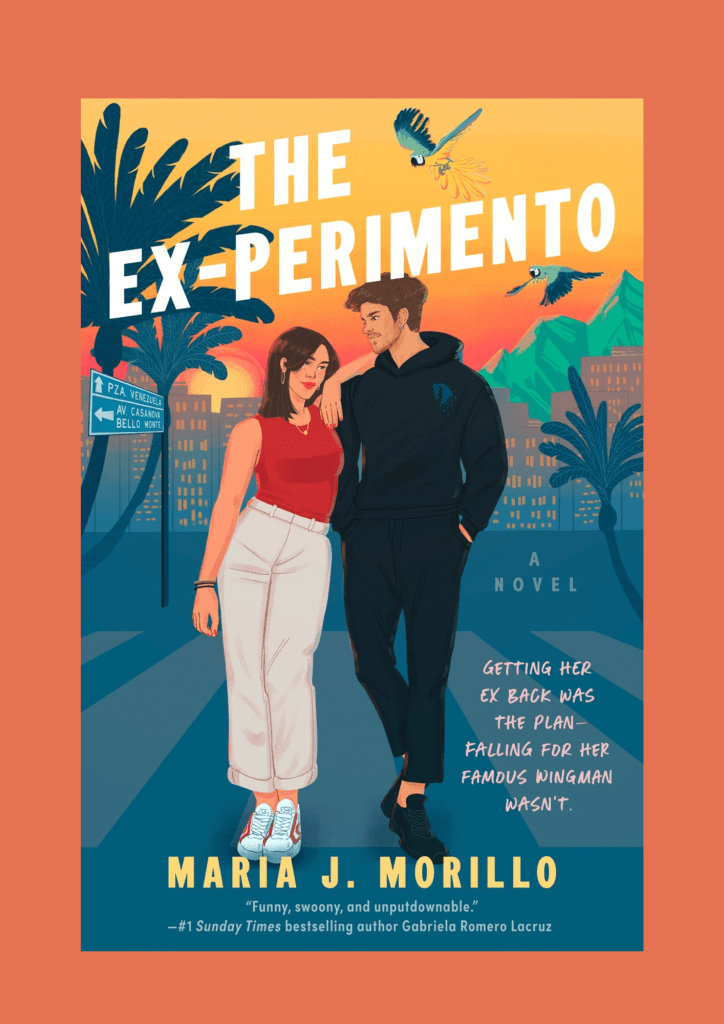
The Ex-Perimento by Maria J. Morillo

How to Lose a Guy in Ten Days, but it’s trying to win back the man who left you after four years together, all with the help of your favorite indie singer. A breakup gone viral, a firing, and a list to fix it all begins this gorgeous contemporary romance debut from author Maria J. Morillo. Bringing readers to Caracas, Venezuela—the people, cityscapes and serene nature— all while exploring the downfall of living our lives solely for other people, The Ex-Perimento is a romance meant to be lived in. Just like our protagonist Marianto, stuck for so long living life for others, this novel forces the reader to experience the journey of finding oneself when we aren’t trying to be what others expect of us. The Ex-Perimento is a story for the people pleasers who twist themselves into whatever everyone else wants them to be, and the reality of untangling ourselves to uncover exactly who we are. Wrapped up in a quest for discovering how to win back an ex while falling for your wingman, The Ex-Perimento feels classic rom com with a deeper pulse of community and want. Morillo understands the atmosphere of the romance, where the city is almost its own character and the characters struggle against suffocating expectations, finding freedom in the attempt to live their lives differently and the romance which evolves parallel to that. Marianto casting off the desires of others to forge a new path of her own making is an altogether freeing journey, as is her romance with Simón who provides her the space to grow and decide what it is she wants. Tied with a sparkling romance that leans into the slow burn and strong Venezuelan roots, The Ex-Perimento is one debut to live vicariously in and savor endlessly.

Preorder a Copy –Out 17th Feb

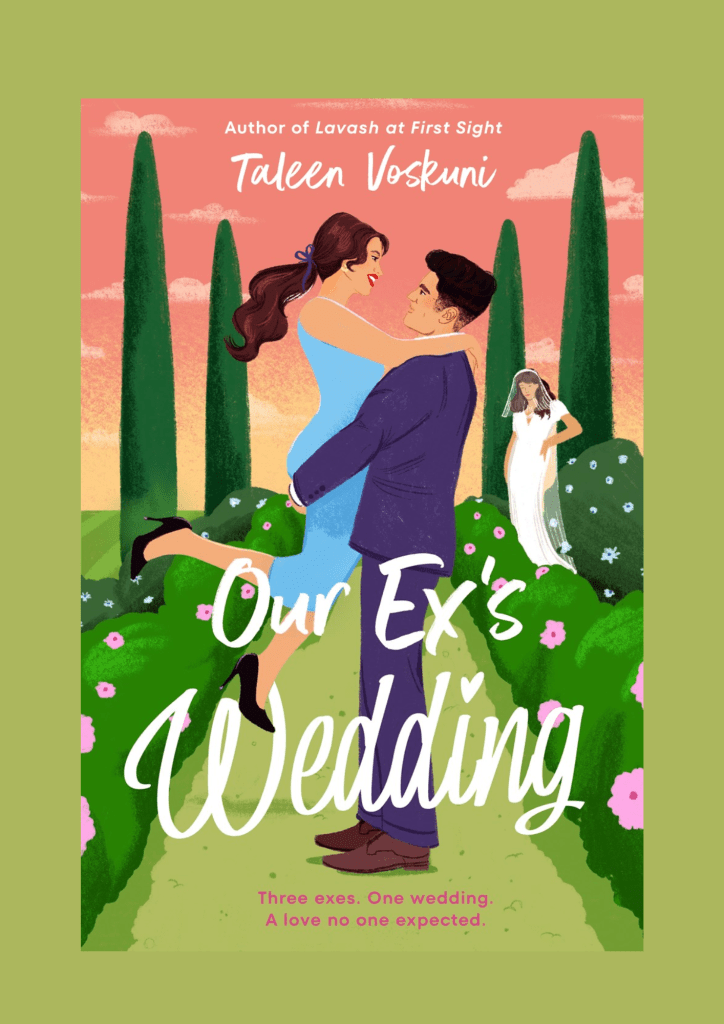
Our Exes Wedding by Taleen Voskuni

What if we found out not only that we share the same ex but were stuck planning her wedding together. Ani Avakian has two problems: credit card debt from a failed wedding and unresolved feelings for the woman who broke her heart. When she gets the chance to plan the wedding of a lifetime for an indie movie star, Ani joins forces with Raffi Garabedian, notorious playboy and owner of the Armenian winery where the wedding is to be hosted. Her initial annoyance with Raffi is greatly surpassed by the revelation that the indie star’s wife to be is Kami, her ex girlfriend. Pulling off the career making wedding is now more important than ever, but it means putting faith in a man she does not like—someone whose heart was also broken by Kami. Taleen Voskuni unveils her third romance, Our Exes Wedding, rich in backstory, Armenian culture, and wedding planning antics. Two perspectives, Ani: the wedding planner and Raffi: the winery owner face past heartbreak as they attempt to pull off the wedding of the year all while fighting for their respective futures. Taleen Voskuni has a knack for intriguing protagonists and this novel is abundant with the character quirks while evolving a truly fabulous romance. Like the feminist book club Raffi stumbled into entirely by accident that helped him better himself, the whisper network, and the queer entanglements. Our Exes Wedding has the kind of setup that makes for not only an incredible romance but deep character study. Characters Raffi and Ani are simply delightful with a magnetic push and pull that kept my heart racing every time they interacted on page. Ani and Raffi love big and fall hard and with all the internal work their love story feels so earned by the time they get their clients to the altar. Our Exes Wedding is big on the details and unconventional in its setup but it all shapes up a wonderful Armenian romance with a queer twist!

Buy a Copy:

Get Over It, April Evans by Ashley Herring Blake

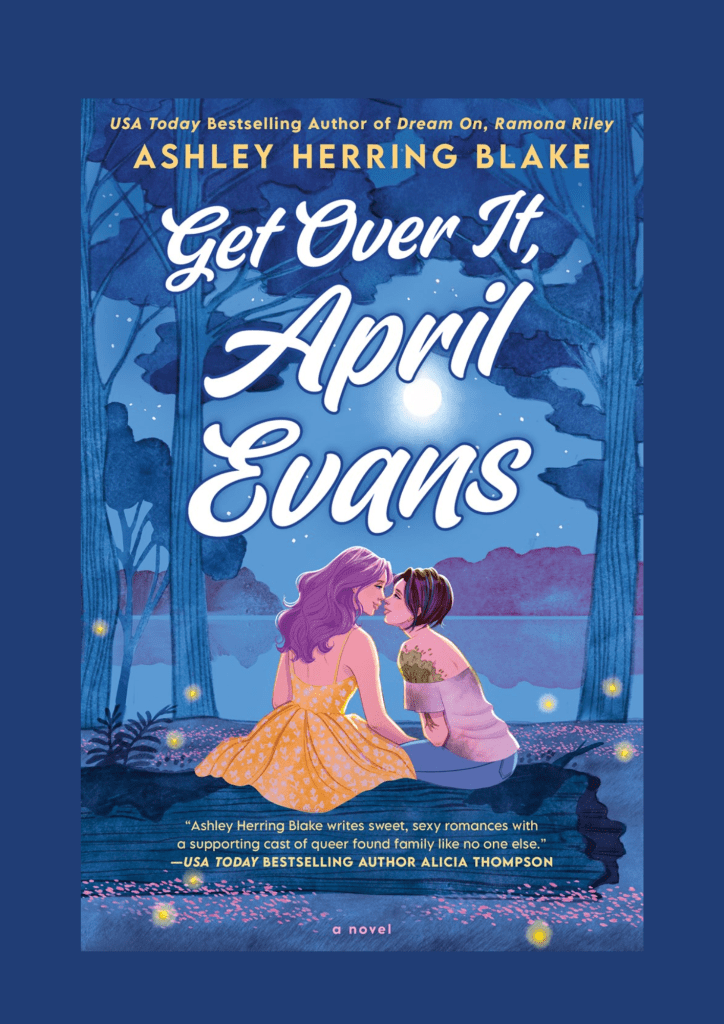
Falling for your exes’ ex while rooming together and teaching a summer art course?? The kind of mess I live for. April Evan’s world is falling apart. Her tattoo business has failed and to make ends meet she’s subletting her house while she’s away for the summer teaching an art course at a nearby resort. But all of these woes are nothing compared to her fiance’s infidelity three years past, when she unceremoniously dumped April for a younger woman. When April arrives at Cloverfield, she’s surprised to learn she’ll be rooming with another member of staff for the duration of the summer—and who should that person be but Daphne Love, the woman her fiance left her for. But Daphne has no idea who April is. Her relationship with Elena is over and done, and the rocky relationship she faces with April in its wake only reveals a forbidden attraction and a chance for them to reach for all the things they’ve been yearning for. Ashley Herring Blake loves mess in her romances and I am just along for the ride. Her latest romance series, Clover Lake, is shaping up to be messy, queer goodness and this latest addition is the imperfect romance we all deserve. Two artists reaching for something bigger, connected by romantic entanglements of the past, serving a bit of “and they were roommates” on a summer art intensive is just the surface of this scintillating romance novel. Since book one I’ve been half starved for April’s story. Our resident tattoo artist lingering upon the past needed her moment and that moment is finally here. Get Over It, April Evans is in large part about the events that shape our lives, and the moment we set them down to rediscover our desires and who we are outside of them. April and Daphne are each on their own distinct journeys, but somehow Ashley Herring Blake is able to draw them together in an incandescent portrait of forgiveness, queer discovery, and an unforgettable New England summer.

Preorder a Copy – Out 3rd February

Daddy Issues by Kate Goldbeck

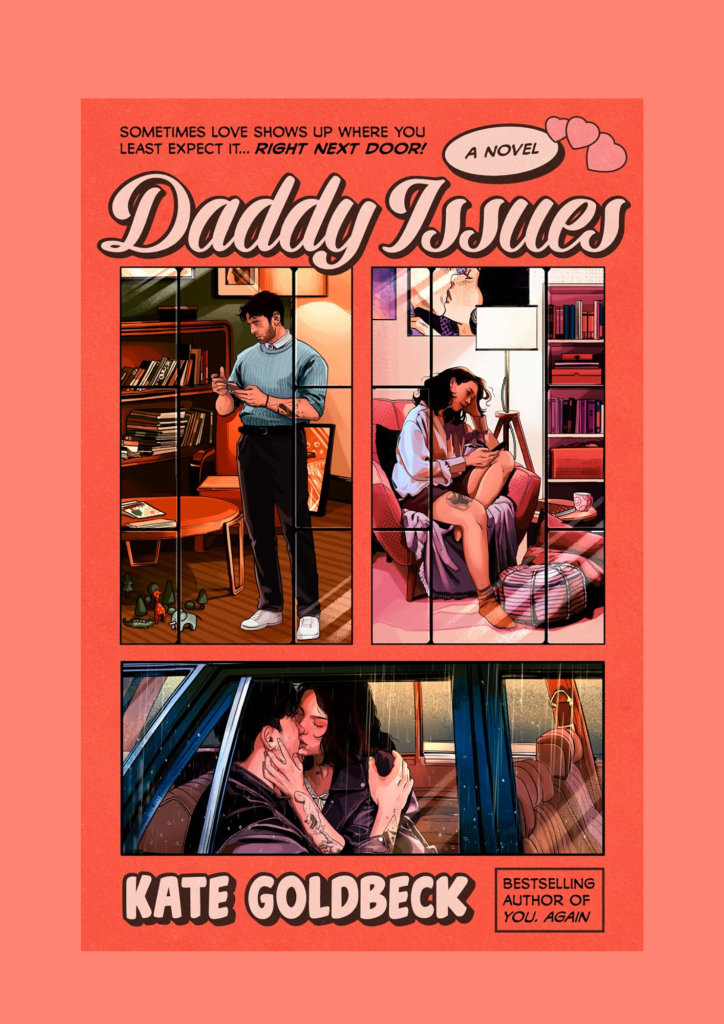
Twenty-six and going nowhere, art history graduate Sam Pulaski has been living at home with her mother since the pandemic. Stuck in a relentless cycle of job hunt purgatory, cynicism, and shame, Sam has accepted her lot in life—at least until she can get accepted into a PhD program and open doors to a job relevant to her field of study. But change cares little for her future plans as her moms upcoming wedding threatens to throw her living situation up in flames. Through all this, Sam makes a connection with her new next door neighbor, Nick, a divorced father, Trekkie, and manager of the local Chilli’s. Their relationship is impossible, a future even more so, but it’s the very thing that has Sam finally reaching for an imperfect future despite her reservations. Kate Goldbeck’s return to the contemporary romance scene is nothing short of iconic. Daddy Issues is an earnest portrait of the mid twenties, perfectionism, and what happens when those who fear failure fail hard. It’s also the perfect novel for anyone feeling lost and aimless in the years following a life altering global pandemic. Mark me down as I’m in this picture and I don’t like it. Daddy Issues portrays this struggle to move forward with such nuance and no loss of humor from Goldbeck, suffusing a comedic core to her sophomore romance. Our heroine Sam is a romance protagonist for modern times, navigating a post pandemic world and the reality that the future she was raised to believe was hers is no longer possible. This loss is a huge part of the narrative, a chasm Sam attempts to cross to a future that feels so far out of reach. Though struggle-ridden and watching a trainwreck-esque, Daddy Issues is fiercely romantic, capital H hot, and endlessly heartfelt. Through all of it Goldbeck has two calls to action: it’s never too late to reach for what you want and moving forward is far better than remaining listless in place.

Buy a Copy:

Seeing Other People by Emily Wibberley &Austin Siegemund-Broka

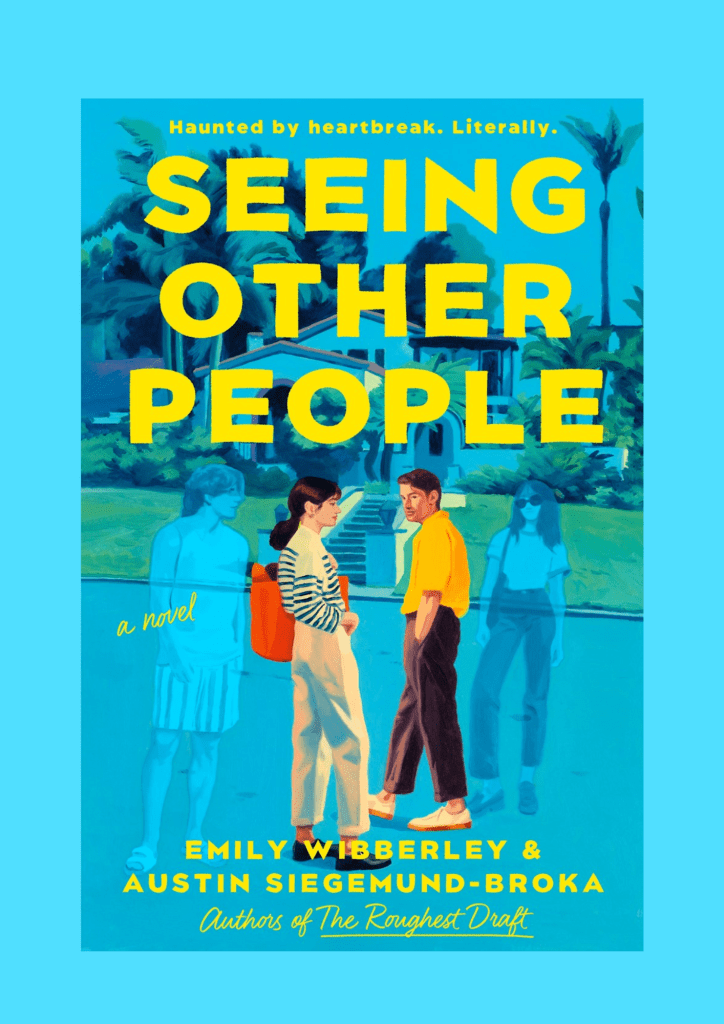
Morgan has a ghostly annoyance in the form of the man she went out with once and he is ruining her life. She would do anything to get rid of him, even venture to a mysterious support group for the haunted. Sawyer has a much different problem: he will do anything to keep his ghost around, even live in a half finished house that has slowly morphed into a haunted one. A chance encounter at the aforementioned support group leaves the two with a plan: Morgan will help Sawyer keep his ghost provided he helps her ditch hers. Excising their respective ghosts is one thing, but uprooting the past will require them admitting the real unfinished business: a chance to love again. Ghosts aren’t the only thing haunting this house in the latest from romance duo Emily Wibberley and Austin Siegemund-Broka. A story about the ghosts we bring with us into our relationships, both the literal and the baggage in tow, Seeing Other People is the kind of love story that both haunts and touches upon the uniquely human aspect of loving: the capacity to grieve. It’s a double edged sword here in this romance where the ghosts are not even haunting the narrative, they’ve got both hands on the wheel. Haunted by a ghost with an appreciation for Carly Rae Jepsen is a blessing not a curse (many would say), but for Morgan Lane her ghost is connected intricately to everything she’s been running from. Sawyer’s is the heartbreaking wave of letting go to move forward after taking the back seat in his own life story. Seeing Other People isn’t just concerned with the possibility of actual ghosts, but in the beautiful moments that spiral out from the connections we make with others—ever expanding in an overwhelming tapestry of compassion and second love.

Buy a Copy:

The Bodyguard Affair by Amy Lea

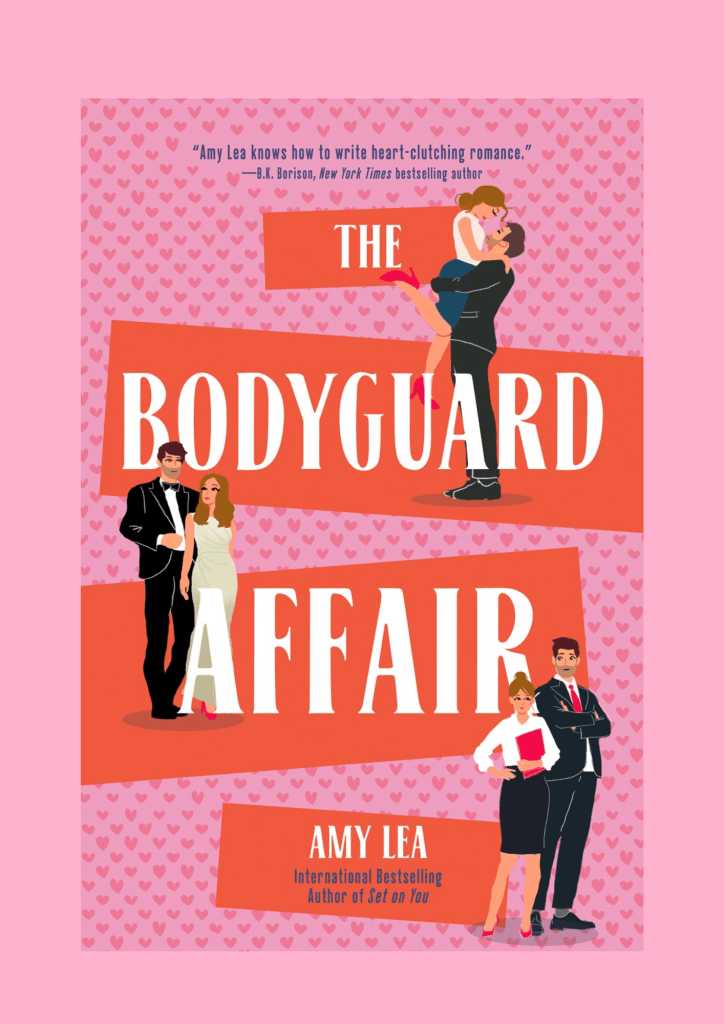
What happens when you work in a public facing government role and your after hours spent moonlighting as a secret romance novelist comes to light? Lie your way into fake dating the prime minister’s personal bodyguard to turn off the heat (this will have the exact opposite effect actually). The Bodyguard Affair is another sensational romance from author Amy Lea that acts as a window into the complexities surrounding forgiveness, family caregiving, and the vulnerability in sharing yourself with the world through story. And that’s all while serving up a truly fabulous workplace fauxmance. Big on the emotions with that slice of Ontario living and tropetastic feel, this book is a love story entirely of its own caliber. Shelve it all the way up to: a book too good to be real. This is the kind of love story that belongs to both its characters—splitting perspectives between personal assistant/secret romance writer Andi Zeigler and bodyguard Nolan Crosby. Where Nolan is wrestling with his childhood parental abandonment as he cares for his aging mother diagnosed with Alzheimer’s, Andi is stuck behind the wheel of her current career and life path as she chases her true passion: writing romance. Both have their own problems and the solution comes out of the most unconventional means—fake dating your colleague to help them out of a jam (said jam being rumors of an affair with your boss because you wrote a spicy workplace romance in your current field). Amy Lea knows how to bridge immense turmoil to the forefront of her narratives without losing the core of the romance novel. That is The Bodyguard Affair in a nutshell, intimately connected to the work involved in building a partnership out of everyday chaos and the exacting art of loving someone else. It’s wild, it’s messy, but the work of loving will always be worth it—one of the most deliberate acts we can ever undertake.

Buy a Copy:

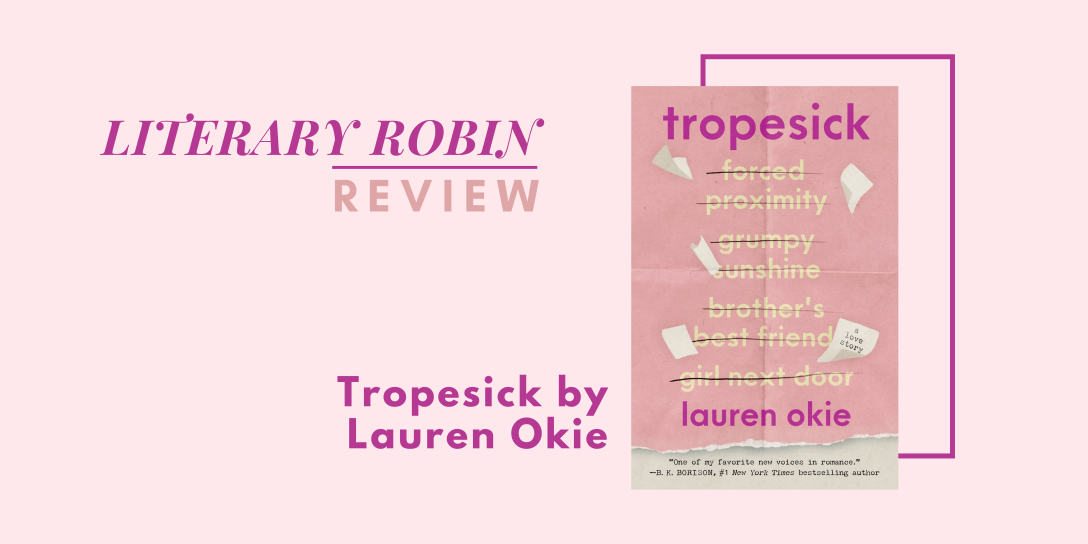
Review: Tropesick by Lauren Okie

Rating: 5 out of 5.

Ghostwriting was never Katie Caruso’s calling. It’s something she stumbled into after college, but it allowed her to pay the bills and so eight years swiftly rolled past. Writing for Meredith Bradford, a household name in the romance genre was once a huge opportunity but now it has become demanding—especially since Meredith keeps pushing up the timeline for each subsequent manuscript. So much so that her agent wants her to work with a writing partner to get the novel done in a matter of weeks. When her initial writing partner cancels at the last minute, who should be asked to fill the space but Tyler McNally, Katie’s childhood crush and the boy who turned his back on her eight years ago. A trope so classic even she is eyerolling (brother’s best friend), their relationship shattered in the aftermath of her brother’s overdose years after an injury that ended his baseball career. Reluctantly Katie and Tyler agree to work together, if only they agree to focus solely on the task at hand. Funnily enough, that isn’t even the biggest problem: Tyler has never even read or written a romance novel. Months out from deadline, Katie and Tyler attempt to construct a story around a series of tropes selected and spat out by Meredith’s cat (no really). But what is even more jarring is that those tropes are playing out in real time and they are making it impossible for them to ignore the past, insisting Tyler and Katie put down the pen and instead turn the next chapter.

Sometimes love means ghost writing a book for a bestselling romance writer with your former childhood friend while it feels like the tropes are screaming for you to be together—because actually they are. Lauren Okie’s sophomore novel Tropesick is a story for the trope obsessed, those who are anything but sick of their miraculous power in the romance genre. Nailing the grit, hurt, and wondrous feeling of reconnection and second chances, Tropesick is the self aware romance novel needed to navigate modern times and modern loves. Tracing the story down the line from one trope to the next, characters Katie and Tyler expose the past, so broken by it that their only way to reach for each other is through fiction, the tropes and the characters a stepping stone to reconciliation. Between arguing over the absurdity of tropes (which keep playing out in real life), discussing which bathroom cabinetry characters could construct by hand—and rail their love interests against, and using their respective characters to speak through the hurt, Okie’s humor and raw emotion is embodied in her two leads and every trope laden chapter. Tropesick is tropetastic, a novel you will want to live in and forever embody. Where the tension is in the backstory and the tropes are as large as life itself this is the romance novel for every romance reader. Of that I am sure.

Three cheers for slutty little glasses, characters who will do anything but communicate, and messy messy love stories. All of this is the Lauren Okie promise. Her sophomore novel Tropesick is definitively her greatest work to date—something that feels akin to cheating seeing as The Best Worst Thing was a life altering romance of the last year. Aligning a romance within a romance where the tropes are as lifelike as they can be, Tropesick is meta, nuanced fun wrapped up in one romance novel. This is an immaculately constructed romance that understands how tropes go hand in hand with narrative (and the way we can define our own lives through them, writing our own ending before it is lived). Through characters Katie and Tyler, Okie explores the classic second chance, the tropes themselves a roadmap on the journey towards these two not just reconciling but doing the proper work of letting go. Tropesick is the kind of love story deeply connected with the act of creating and the personal nature of writing about our own struggles. Modeling the three act structure of the manuscript our two main characters draft side by side, Tropesick develops its own story within the story even as the narrative pulls focus on the writers themselves. Using their characters to challenge the status quo of their relationship and force the past to present, Katie and Tyler may not even be aware of it, but it is not just the tropes forcing the issue but very much themselves.

Not even going to lie, this may be the romance novel to end all romance novels. I mean there are lines from Tropesick that have played on a loop in my head for days after reading (I’m looking at you line from the third act involving the word “humiliating”). I love how many feelings I oscillated through on my Tropesick reading journey: pain, elation, shock, hope, and happiness—oftentimes a mix of all five. This is truly an example of how much romance can tap into our humanity and nail differing tones and themes across a single novel. That’s partly why Lauren Okie deserves all the flowers, but even more so her innate pulse on the genre and how to play with its conventions using tropes as the foundation. Tropesick achieves a level of self awareness unrivaled in the modern love story, so on the nose it can be considered nothing short of genius. Including a green flag of a man (heavily tattooed, regretful, reads the books you assign him) Lauren Okie truly understands what romance readers want even if it is something they don’t expect. Beginning with a truly horrifying ordeal—an imminent deadline, Tropesick details a second chance, a love worth reaching for if its two leads can just lay waste to their ghosts and finally accept the hardest thing ever: the possibility of happiness. Count me in as not tired of tropes in romance novels, especially when they are as cleverly applied as this one.

Thank you to Michelle and Avon books for sending me an advance review copy.

Trigger warnings: Drug overdose, addiction, drug abuse, drug use, death of a family member, grief, emotional neglect, parental abandonment

Preorder a Copy — Out 16th June

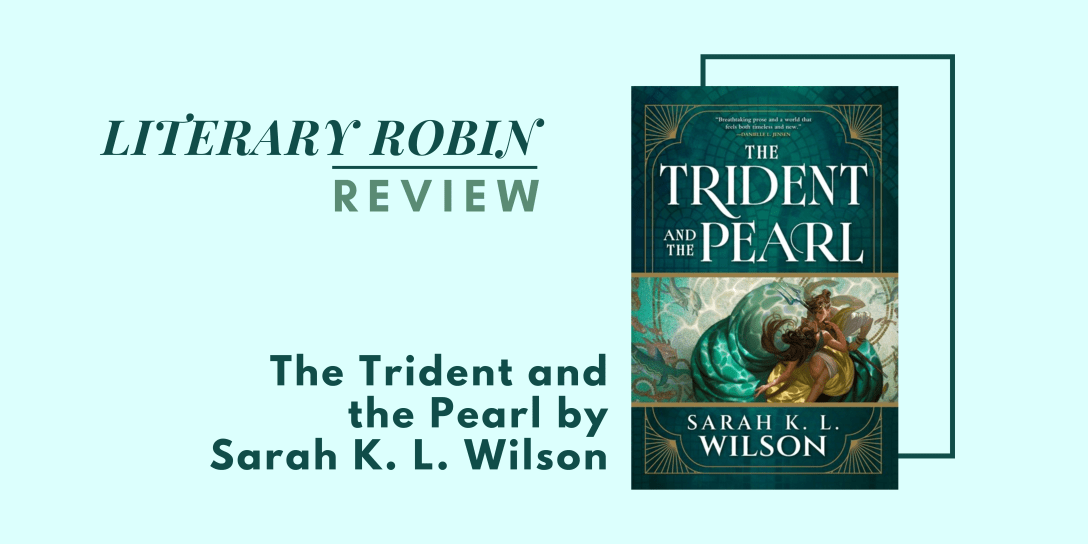
Review: The Trident and the Pearl by Sarah K. L. Wilson

Rating: 4 out of 5.

On the day her world drowned, Queen Coralys made a bargain. Desperate to save her kingdom of isles from their watery fate—one to which her husband had already succumbed, Coralys made a plea with their gods who at the last moment saved the islands for a price. In trade for her world restored, the gods strip Coralys of her queendom and order her to marry the first man who returns to the shore. Hoping for a prince or a duke, Coralys is instead given a fisherman who appears on the dock horrifically wounded and burnt from days spent in the sun. Given no choice but to wed this stranger, Coralys has no idea the man to whom she is betrothed is actually the god of the sea, the very god who was supposed to protect her islands and to her belief shirked in his duty. Mistrusting his motives, Coralys decides to control her own fate and chase revenge: kill the god who allowed her world to drown and take his power for herself. When it is revealed exactly to whom she is wed, Coralys soon grows to understand the world of scheming gods, of which she is unfortunately a pawn. As her husband reveals hidden depths Coralys is caught within a deadly tide: to pursue revenge or follow a new path to become a weapon all of her own making.

Drown under the weight of the waves in Sarah K.L. Wilson’s turbulent debut The Trident and the Pearl, where few bargains are as desperate as the ones we make before our end. Recounting a marriage of convenience between a queen stripped of her station and a god struck low, Wilson’s romantic fantasy novel puts new meaning on revenge and the path towards fulfilling that desire. Mainly it is okay to stab your husband through the chest, encouraged even. The Trident and the Pearl does not hesitate to drive that spear in deeper with a slow burn romance between our wedded pair: Okeanos, god of the sea, and Coralys, mortal once-queen hell bent on revenge against her godly husband. A recipe for tension if there ever was one, The Trident and the Pearl pulled me deep into the undertow to entangle in the deadly machinations of gods and reflect on not just godhood but the weight of holding such a power. Wilson’s attention to romantic yearning elevates this novel even further, a romance caught between hatred, vengeance, and what we owe to those whom we lead. Atmospheric and rimmed in sea foam, Wilson’s series debut manages to strike the perfect course, an ebb and flow between romantic yearning and the stratagems of fickle fickle gods. Rough seas turn rougher with bargains, quests for revenge, and gods in the mix, making this sea positively treacherous.

Reading The Trident and the Pearl has reminded me how much I miss a classic tale of godly scheming. Those stories which involve gods not as beings of pure intellect and rationality, but idiots and sometimes…simply just a guy trying his best and failing horribly? My taste down to the exact detail. Where the machinations are overly ambitious and humans are mere players on a chess board, The Trident and the Pearl feels like a return to the myths of my childhood and it is certainly a long-awaited homecoming. This has all the ornamentation of a classic godly tale: a heroine desperate to save her people, a double sided bargain, and a marriage between god and mortal. Set in a land of interconnected islands, The Trident and the Pearl feels both expansive and close knit much like the ocean itself, a comforting balm and a dangerous swell. The romance follows a similar pattern. Unhinged yearning is one thing: but yearning for the wife who wants to kill you and the man directly responsible for your rumination is entirely another. Before I read this book I had no true idea of the intimacy in killing—both in the person driving the weapon in deep and the person looking on helplessly, pulling the weapon in deeper. All to say Coralys and Oke don’t exactly fit any romance dynamic I’ve ever read, instead opting for chaos and disorder, which only further aligns this myth-like quality Wilson constructs with her debut.

The Trident and the Pearl takes a meandering path to the center of the storm in an engrossing final act that left me half drowned and bedraggled in its wake. In such a character focused tale I can only be happy this one took its time to lay the footwork because it makes those final chapters all the more merciless. Coralys’s struggle with her quest for revenge and the aftermath of that choice makes the mid section of this novel more internal—pensive. The Trident and the Pearl is concerned with choices, the crossroads we reach and the paths we take forward. What happens when the goal we’ve been chasing is achieved, and how are we transformed in the aftermath? One thing I appreciated about the mythos we’re introduced to is how godhood is a constant battle to retain one’s immortality and control the power you do have. The relationships between gods are more volatile, the moves and counter moves a result of a desire to amass more. Coralys is a unique character in that regard, not unfamiliar with power and responsibility to the people she leads, but grounded by her humanity. Being responsible for the well being of others is a connection she shares with Oke but against their opposing ties that connection may not outlast a secondary crossroads. Sarah K.L. Wilson’s The Trident and the Pearl is as uncommon as the pearl that makes its name, a fantasy novel worth plumbing the depths to learn all of its innermost facets. At this point I’m lost in it. Count me as on board the second (minus any drowning to the depths). 

Thank you to Orbit and Netgalley for providing this advance review copy.

Trigger warnings: death, violence, blood

Preorder a Copy – Out 24th February

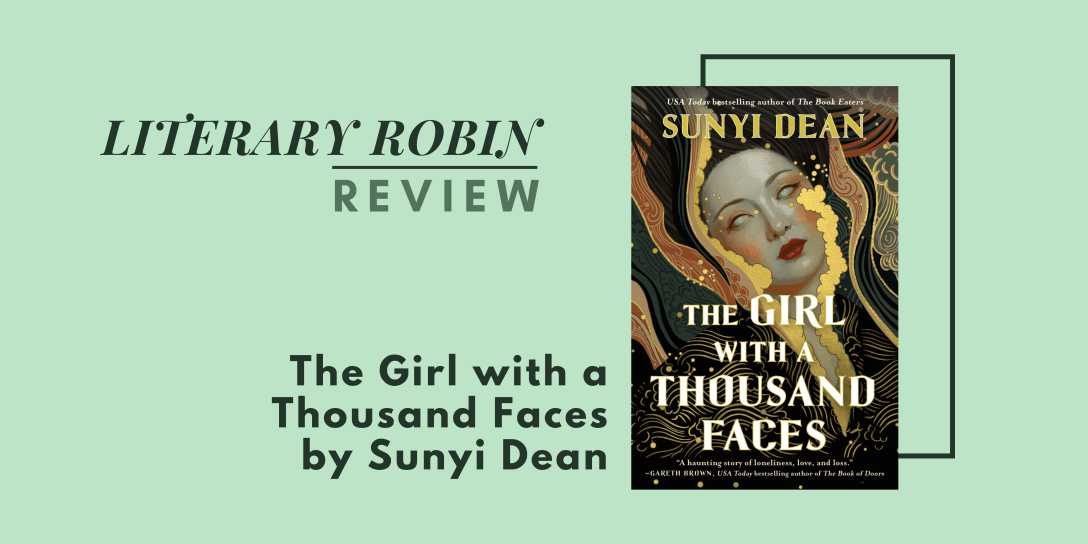
Review: The Girl with a Thousand Faces by Sunyi Dean

Rating: 5 out of 5.

Kowloon is a city of ghosts. For a girl with no memories washed up upon the shore, it presents an opportunity for a rebirth. Mercy Chan has a unique ability: not only can she see ghosts, she can commune with the dead and allow them to move towards the afterlife—a rare talent coveted by those who make Kowloon Walled City their home. For decades Mercy has worked as a ghost talker of sorts in connection with the Kowloon triad. She spends her days communicating with the ghosts who linger, usually the angry and wronged, bringing justice to their afterlife and to the city itself. But something darker lurks in the shadowed spaces, luring citizens to their watery deaths and speaking to Mercy through the bodies of the departed. With a proposal to demolish Kowloon up next on the docket, a serial killing spree could be what allows the legislation to pass. Even more sinister, this killer appears to have a personal connection to Mercy and is intent on drawing her close to their crimes almost as if in retaliation for something. The answer lies deep in the past in memories Mercy is unable to access. As Mercy follows closer and closer to this ghost, the less she can deny that the vicious spirit is on a quest for revenge and the object of its ire: Mercy herself.

A ghost-talker confronts her missing past and the ghosts that linger in Sunyi Dean’s historical gothic feat, The Girl with a Thousand Faces. It feels like eons since I first discovered Sunyi Dean and drifting back into her work feels as languorous as a cat taking a long stretch in the sun—entirely out of sorts with the actual tone of Dean’s sophomore novel: a historical gothic fantasy all about ghosts and the cycles we perpetuate. The Girl with a Thousand Faces is as cutthroat as the ghosts left to steep in sadness, anger, and regret. At the helm, Mercy Chan, a fifty something ghost talker with a mysterious past facing down a ghostly killer intent on forcing her to confront her own forgotten ghosts. The Girl with a Thousand Faces makes the reader into a kind of specter, wandering Kowloon Walled City alongside Mercy as she unravels the past. Dragged down deep into waters ancient and strange, Sunyi Dean weaves a startling narrative that will have you questioning the true villains, be they paranormal or man made. Vindictive ghosts are one thing, but Dean’s true talent lies in her glimpse into the real horror beneath, the devastations of war, grief, and generational traumas—with everything a cost of ignoring that pain. Brave this strange ghostly saga and whatever you do don’t look down.

The Girl with a Thousand Faces is a bit of a genre-bend, equal parts historical, fantasy, and gothic that begins to take shape through the unique setting of Kowloon Walled City. Setting is everything within a gothic novel and Kowloon, a city of ghosts (both human and paranormal), could not be more perfect for the story Dean constructs. Right away you can feel the claustrophobic nature of this densely packed city, a community of humans and ghosts that is home despite efforts to demolish it post-war. Kowloon is very much a city that reflects the pain that cannot be buried, of real people attempting to make a living after enduring the horror of the second World War. It makes sense then that ghosts have congregated within its boundaries and have continued to flourish even in the decades following. In a city rife with ghosts, Sunyi Dean questions what are the real ghosts—are they the literal phantoms and wraiths clinging to life, or do they represent a darker part of our humanity that we refuse to examine and excise. The Girl with a Thousand Faces presents an interesting duality in its perspectives, both ghost and human, to interrogate not just this essential question but how ghosts themselves come to be.

Much of what makes this book so hard hitting is the humanity underlying the horror. That we create our own ghosts which follow us and our descendents is far more horrific than the literal ghosts appearing within the narrative at times. There is a grief that comes alongside knowing this, in understanding that Mercy’s story is the result of pain endured by her family and a suffering that was never addressed generations prior. Relationships between sisters, mothers, aunts, and nieces, are all part of this delicate tapestry and a pain that went unanswered. These relationships are the beating heart of The Girl with a Thousand Faces and the nuance in depicting motherhood, specifically the relationship between mother and daughter were some of my favorite parts of the novel. Siu Yin and her mother, dancing and swimming with ghosts rather than reaching for each other in hard times, cogs in a relentless cycle that initially appears impenetrable. Throughout this complex web, Dean underpins the staggering traumas of war and colonialism which shape us and those who come after. In the aftermath, sometimes the pain caused is too great and by trying to hide it we cause more, leading to further tragedy. The Girl with a Thousand Faces knows the work of grieving and moving forward is a heavy burden, but it is essential work and part of freeing our own inner ghosts.

The Girl with a Thousand faces is the best thing a book can be: clever and horrifying as hell. While it has been some time between Sunyi Dean’s debut, The Book Eaters, and her sophomore novel, I would wait twice as long if it means she can keep delivering books such as this one. The Girl with a Thousand Faces is certainly one of the most interesting historical novels I have ever read. A ghostly jaunt through a post World War Two Hong Kong—specifically Kowloon Walled City—as Dean examines what makes a ghost and what it takes to truly reconcile them. The Girl with a Thousand Faces nails all the bittersweet facets of forgiveness and how essential it is to breaking the cycle of grief and trauma. Not without its heartbreaking moments through others who did not have the language to do the work of grieving, instead languishing in that pain and trauma and never fully surfacing. Though horrific, grief ridden, and painful at times, there is a tremendous joy found in breaking the cycle, in doing the hard work of reconciliation. Certainly not an easy path but one that is worth the work. Sunyi Dean doesn’t deny that we don’t always get the answers we’ve been longing for, craving an understanding from our family members who are long gone, never there to give us greater context. Those can be ghosts too, following us ever long even as the cycle is rented in two. Haunting yes, but fiercely hopeful, The Girl with a Thousand Faces asks us to trust in the haunted and dare to sink knowing we will eventually surface—if we can just make that leap.

Thank you to Edelweiss and the publisher for providing the advance review copy.
Trigger warnings: violence, murder, depression, death of a parent, grief, war, mass death

Preorder a Copy — Out 5th May

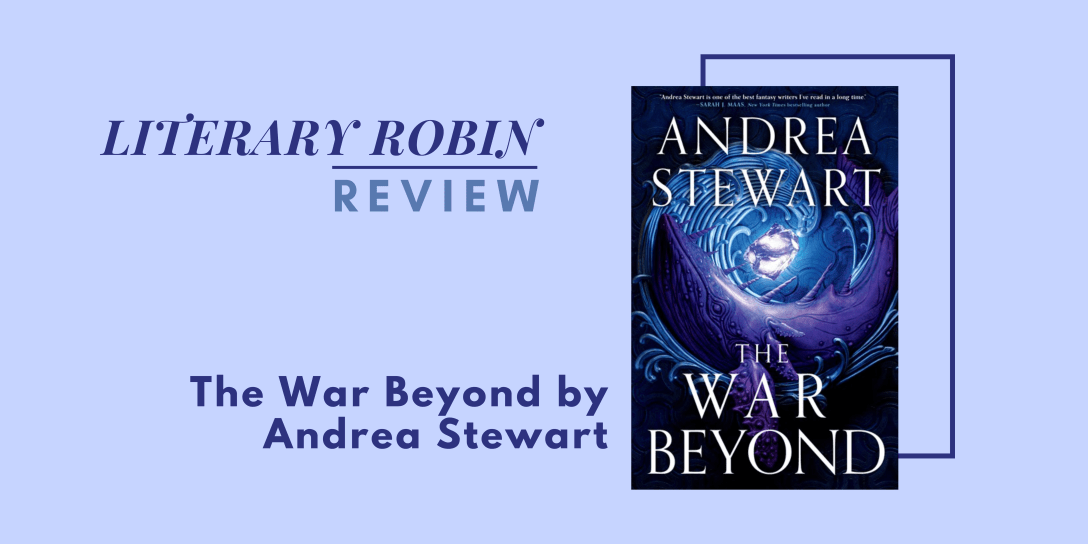
Review: The War Beyond by Andrea Stewart

Please note this review contains spoilers for the former book in this series, The Gods Below, and contains references to some of the events in this sequel. Read with caution. 

Rating: 5 out of 5.

To reunite with the sister she unwittingly abandoned, Hakara risked everything. Now face to face with her sister Rasha after ten long years, Hakara knows she is beyond saving. For Rasha is an altered, one of the humans transformed by the god Kluehnn as he restored their home country, and she will not leave her place as a godkiller nor give up Kluehnn’s will as the one true god. Hakara and the Unanointed rebels instead decide to track down one of the elder gods, Lithuas, who betrayed her elder comrades in an act that ushered in Kluehnn’s reign and spelled their demise. Capturing her could provide valuable intel, and swaying her to their side even more. Back in Langzu, Sheuan plays a dangerous game in allying herself with the Sovereign in marriage, but she knows he hides secrets. Meanwhile, her cousin Mullayne searches for Tolemne’s tomb, the human who bargained with Kluehnn centuries ago. If he can discover the truth beneath the legend, perhaps they can learn Kluehnn’s master plan and why Tolemne returned to the surface. Across the fractured continent war is kindling. Hakara harnesses a great power in the corestone suffused with untold power, but she won’t stop even if using said power costs her life. Rasha begins to question the teachings of Kluehnn and if war is exactly what he wanted all along. On opposing sides of a war between gods, Hakara and Rasha’s loyalty is no longer to each other. Restoration is coming and only the answers in the past could turn the tide and help bring about the end to a violent god.

Andrea Stewart’s Hollow Covenant trilogy bridges the gap between climate fiction and high fantasy in a climate ravaged world where humanity is at the whim of a vengeful god who promises restoration with a price. In her sequel to The Gods Below, Stewart demonstrates her breadth of both plotting and storytelling as she amplifies her godly war and the history of centuries past to plunge ever deeper into revenge and the cost of excess on generations. As her four characters face down a restoration event, Hakara and Rasha, sisters separated by circumstance, find themselves on opposite sides of a war over the future of their world. Sheuan plots and Mullayne continues to pick at the threads of the past. Loyalties are tenuous at best and Stewart proves just how much in a sequel that questions the cost of vengeance and whether transformation is the true catalyst of change. Four perspectives, all concerning some aspect of the truth, are split apart on a shattered landscape, and as time runs out they will piece together the past behind the stories they’ve been taught to believe. Vengeance, grief, loyalty, and love coalesce in The War Beyond and it’s nothing short of world altering. With countless perspectives and a wealth of history to get lost in, the Hollow Covenant speaks to the best of the fantasy genre, and something tremendously human captured within a fantasy setting: consumption with no thought for consequence. 

The War Beyond is the novel that took me from interested to eternally invested in the Hollow Covenant trilogy. Like coveted gods gems I gobbled up all of the character perspectives, lore, and rich history of this shattered world, left temporarily transformed in their wake. For a world utterly expansive in measure there are so many things to admire and take away from Stewart’s trilogy. Mainly Hakara and Thassir who I would like to put in my pocket and protect from harm (I say while still craving the incredible angst that appears whenever they are in the same room together). From the moment I first heard the pitch for the Hollow Covenant series I knew it had the capacity for greatness: a decimated climate the result of human consumption, future generations left to toil for a better world, and gods hunted to extinction by an opportunistic being who promises a return to the world humanity destroyed. However, it wasn’t until this sequel that these all sunk in for me as Stewart uncovers more to this history and the motivations of core characters. The World Beyond is a fascinating sequel excelling on the basis of story, to world, characters both major and minor, and the romance subplots (oh the subplots). Four unique perspectives: the altered, the rebel, the spy, and the explorer take a larger stand against the change being wrought in their world—to succeed or be irrevocably altered in its wake.

Andrea Stewart reveals the depth of the deception across the centuries through her focus on the power of information systems in dispersing the truth. To control how information is recorded comes with the ability to control the narrative no matter how inaccurate—an essential component to how things develop within this sequel. Through the epigraphs, the known history of The Shattering, the burning of the Numinar trees, and Tolemne’s path, Stewart lays clues to Kluehnn’s motivations and his rise to power centuries prior. Many of these primary and secondary sources become suspect with just one sentence as Stewart unveils her revolutionary plot twist. And what a twist! I can count on one hand the plot reveals that have left me floored as I try to pick up the pieces, and I can now count The War Beyond amongst them. Very much here for the plot twists that recontextualize the playing field and history while deepening the knowledge we have on our antagonists. The War Beyond does this perfectly while instigating the next stage of this narrative. As this book nears its end, Stewart hammers in the power of oral storytelling and the impact of information systems that have broken down in the aftermath of a world altering event. The result is misinformation and our characters grapple with this while endeavoring to right the wrongs taking place within their world.

In reaching the end of The War Beyond comes the question: how to move on. And if that’s not the mark of an excellent book I don’t know what is. Stewart’s follow up certainly feels timely, homed in on a world decimated by a changing climate and the current generation left to atone for the sins of the past. Tethered to the past and their alliances, each of our core perspectives understands the unerring call: they may not be the direct cause but they are responsible for righting the problems in their world. The heart of these perspectives continues to be sisters Hakara and Rasha whose lives were sundered following the destruction and rebirth of Kashan. This theme of sisterhood is such a strong tether within this series and it is tested in the pursuit of revenge and worship for each sister respectively. Hakara’s desire for revenge is mirrored in the most unexpected way as Stewart reveals how all of these world altering events have been driven by revenge and retribution in some manner. Really cannot emphasize how brilliant the central plot twist is for this sequel (I am still thinking of it weeks after). There are still many mysteries afoot when it comes to the history of this world and the actions of the elder gods. Thassir in particular continues to be an iconic grieving cat protector and I loved seeing him level up and take back the godly mantle he had abandoned. The War Beyond is just all around a superb sequel, digging deeper into the dark to unearth the past and transform an unsteady world. Stewart places her characters on the path to intervene with a god and I know I will come out just as altered before its end.

Thank you to Netgalley and the publisher for providing me with an advance review copy.
Trigger warnings: death, blood, murder, mutilation, body horror

Buy a Copy:

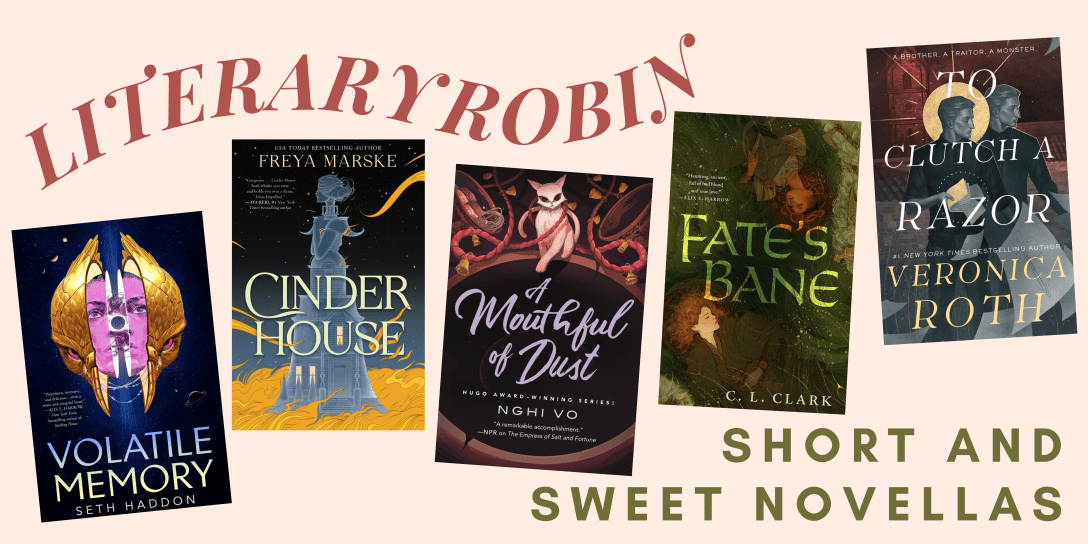
Let’s Talk: Short and Sweet Novellas

My favorite thing is whatever Tor dot com has got going on in autumn. Whenever I’m feeling stuck with what I’m reading, I can always count on Tor dot com to bring me back with their stellar offerings in short fiction. There are so many new authors to try in this range of fiction and honestly some of the best concepts first began as novellas—see Alix E. Harrow’s, The Six Deaths of the Saint. This season is giving us Veronica Roth’s sequel to When Among Crows, the next book in the Singing Hills Cycle (Nghi Vo my love), and some really amazing queer speculative journeys. As part of my elaborate plan to reach my yearly reading goal this month I’m reading an entire slew of novellas and telling you all the one’s that are worth your time. Short and sweet is the recipe for success here so look no further for the books to take you to new heights!

Disclosure: I will be linking my Bookshop affiliate link below my reviews. I earn a small commission if you purchase books through this link and it is one way to support my reviewing! My affiliate link will simply be labeled “Bookshop.”

To Clutch a Razor by Veronica Roth

Real found family-ism is letting them help rob your birth family. Months after surrendering his bone sword—the weapon all Knights of the Holy Order possess, tethered to their souls and sheathed into their spines, Dymitr is ready to bargain it back. The trade for his transformation into a Zmora by Baba Jaga, the feared witch isn’t willing to just hand it over for nothing. Her price: the death of his grandmother, one of the Knights legendary hunters. Not willing to kill a member of his family, Dymitr instead plans to steal her book of curses, hoping it will be enough to unite him with the other half of his soul. Veronica Roth’s Curse Bearer is a dark urban fantasy gem rooted in Slavik folklore and given new life in modern day Chicago. It’s the kind of bite sized adventure that fills the space of a larger novel, sating the appetite without the high page count. To Clutch a Razor returns readers to our precarious found family as they continue to clash with an order intent on their eradication. Dymitr is now counted among them, as he has cast off his status as Holy Knight, to become something he was taught to destroy. Alliances and bargains bring together different motivations in Dymitr, Niko, and Ala in this sequel as they travel to Poland for a funeral, for an assassination, and a heist—all in the home of Dymitr’s family, one of the most revered in the Holy Order. A former knight, a zmora who feeds on fear (and has an innate talent for illusions), and a strzygi who feeds on anger make for a great trio. To Clutch a Razor will put their bonds to the test in some of Roth’s best writing to date. Dymitr’s journey to atone for the past and the sins of his family is the still beating heart of this series. To Clutch a Razor is a valiant display of bravery in not just becoming the monster in order to stop being one, but facing the greatest monster of all: your family line.

Buy a Copy:

Psychopomp and Circumstance by Eden Royce

In death, there is no greater honor than the pomp, the role of planning the funeral service for the newly departed. When she learns of her aunt Cleo’s passing—years after she was exiled from the family, Phee St. Margaret goes against her family’s wishes and volunteers to pomp the dead—to travel to the town her aunt made her home and plan the funeral. At the home of her aunt, the dead may not really be dead, and various objects clue the truth to her aunt’s estrangement with her family. Though the task may be daunting, Phee will pomp for her aunt and stand in place for a future she never expected at all. Psychopomp & Circumstance is a quieter novella, but brimming in the Southern Gothic tradition and the history surrounding the Reconstruction era South. Emotional and haunting, Eden Royce knows how to establish a firm tension in her narrative through family wounds, secrets, and the goings of an unknown town. With a pomp to accomplish, the heart of this tale is held in our heroine Phee, who grapples with the expectations of her family to marry well, against her desire to do more. Royce’s portrayals of the pomp and the importance of death rituals is not to be denied and perfectly wound up in Phee’s arc in reaching for a larger role and standing firm in her autonomy. Though the setting of Cleo’s house is unsettling, it is the anxiety of successfully pulling off this service that is felt so close to the surface. Phee’s emotions and the secrets buried within a house and family make this novella a positively unnerving read, yet unique and eye opening all the same.

Buy a Copy:

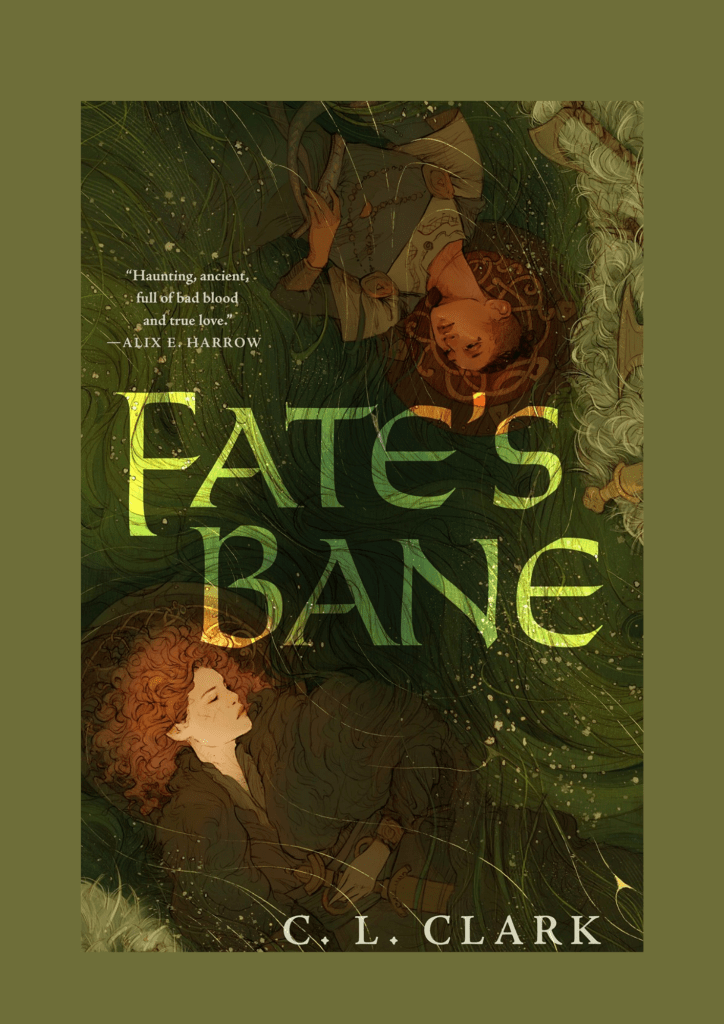
Fate’s Bane by C.L. Clark

Another sapphic fantasy story from C.L. Clark? The world rejoiced. Held captive for many years by an enemy clan, Agnir is raised alongside the children of their chieftain as his ward. Ever held at arms length, held hostage to continue the peace, Agnir falls hopelessly and recklessly in love with the chieftain’s daughter, Hadhnri. Together they harness a magic that could transform the clans of the fens, if they can at first endure a bitter separation. Fates Bane is a perfect novella for the fantasy obsessed, or anyone looking to get a slice of sapphic tragedy with half the page count. Anyone familiar with Clark’s writing knows they aren’t afraid to go for the jugular and that is decidedly the spirit of their latest novella. Fates Bane serves a sapphic childhood friends to enemies to lovers romance alongside clan wars, conflicting family bonds, dangerous forests, and leather soaked in magic. With a story like this, it’s evident how everything is carefully arranged, allowing every word its maximum effect—the story to become its own kind of legend. Fate’s Bane is heavily immersed in tales retold and reinterpreted, and just reading it becomes an integral part in the making of things. Blade sharp yet comforting in its forbidden love and familial bonds, Fate’s Bane exquisitely toes the line between competing loyalties and an inevitable clan confrontation left in the fallout. The result is an action packed third act and an ending that will shape you in disbelief. Relentless, inevitable, Fate’s Bane is the kind of story told at midnight between the weeping willow fronds with all the promises of devoted youth made sacred through love and hidden magic.

Buy a Copy:

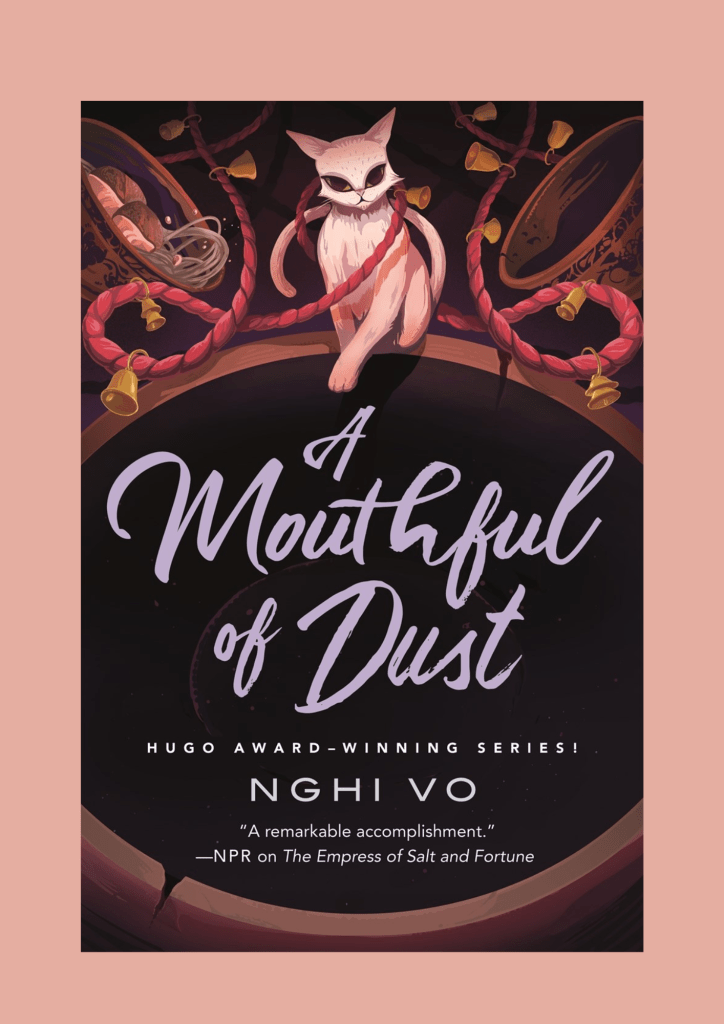
A Mouthful of Dust by Nghi Vo

We’re back with the wandering Cleric Chih and their stalwart hoopoe companion, Almost Brilliant as they travel the land recording stories. This time the history of a village plagued by famine beckons. Known for its slow roasted pork, but even more for its three year famine of eighteen years past, the village of Baolin still bears the wounds of hunger, starvation, and mass death. Plagued by a famine demon with a hunger never slated, Chih is more curious of the secrets held by the wealthy and powerful of Baolin. Upon their arrival, Chih is taken and sequestered inside the manor of the local magistrate where they learn just now much secrets cost and the lingering proof of complacency and violence. If you know Nghi Vo, you know her novellas are some of the best in short fiction. A Mouthful of Dust is another incredible addition to her The Singing Hills Cycle, following an inquisitive cleric as they wander and record the stories of the land, and find themselves embroiled in danger, feuds, and murder plots more often than not. The fun of this series is the contrast between, where genre blurs but the commitment of our main character never wavers. A Mouthful of Dust contrasts accounts of the working class with those in power all centered around a life altering famine event in Baolin. In some, a famine demon bargains over pork, in others, the demon poisons the land and the people starve. It’s a fantasy story tinged with horror, but the claws dug deep into Baolin do not just belong to a malevolent demon ever hungering, but real human things. Hidden white cats, delicious pork, dark secrets, and cannibalism make up this next section of Singing Hills and all serve its continued calling for storytelling and enduring memory.

Buy a Copy:

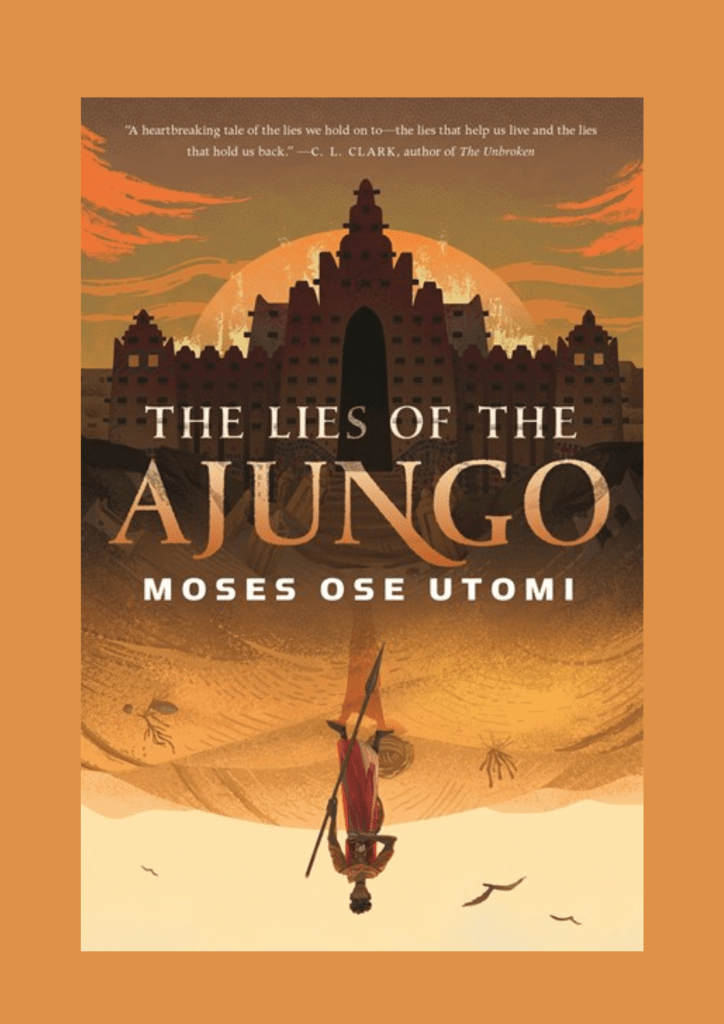
The Lies of the Ajungo by Moses Ose Utomi

In The City of Lies, Tutu has grown up knowing only one thing: there is no water, there are no heroes, and there are no friends beyond its walls. At the age of thirteen, all citizens lose their tongues and the ability to speak—all to trade with the mysterious Ajungo empire and the meager water they provide. As his mother succumbs to dehydration, Tutu makes a deal with the city’s Obo: water for his mother in trade for his journeying into the desert in search of a water source. A journey that will transform not just himself, but the city he thought he knew. With his debut novella, Moses Ose Utomi proves you don’t have to write a full length story to have a narrative impact and pack a punch. A simple quest narrative is anything but with The Lies of the Ajungo, as a young boy travels into the desert and discovers the bones of the past children who searched for more and a strange group of women from a nearby city. From Tutu’s journey to the individuals he meets upon the way Utomi shows the act of narrative in defining a society, providing a common villain to hide the real violence taking place beneath the constructs of a city. The act of speaking, hearing, seeing, are all vital for truth telling in unique respects. The Lies of the Ajungo plays these senses in tandem revealing a system that deliberately ripped them away from a populace to hide the truth and benefit the powerful. Tutu’s journey is one that will stick with you as he navigates desert oasis, would be assassins, and the facades of friends and enemies. Concerning storytelling, history, and oppression, The Lies of the Ajungo dares us to see beyond the stories we’ve been told to what lies beneath—a writhing, shameless abuse built and carried out with startling intent.

Buy a Copy:

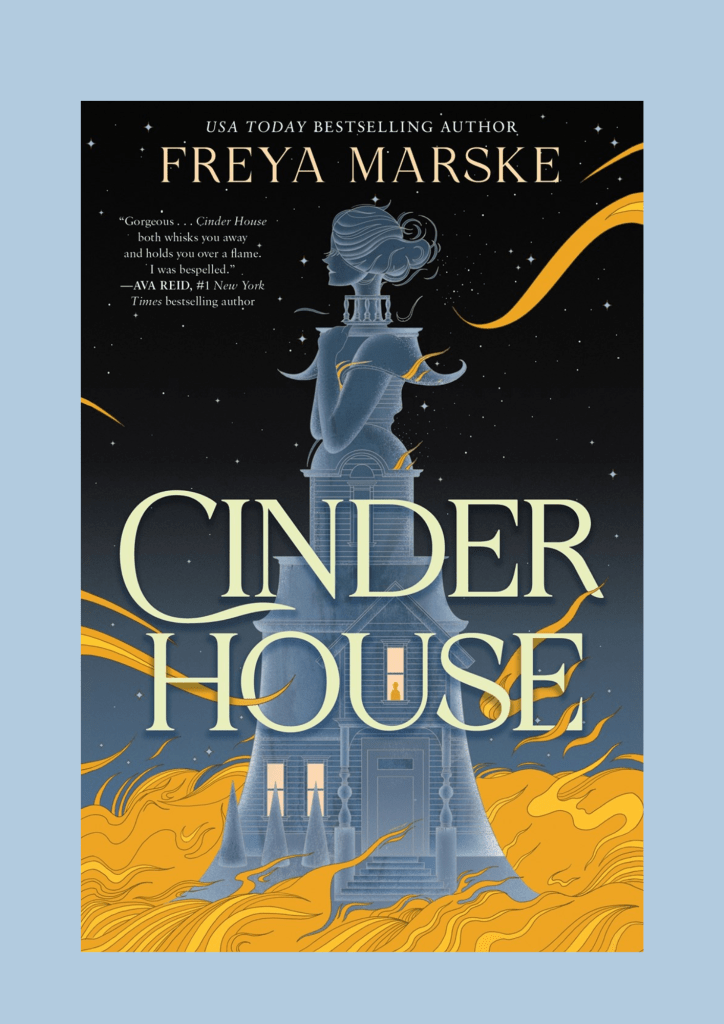
Cinder House by Freya Marske

House ghost, but literally. When her father was poisoned, sixteen year old Ella should have inherited everything, had she not promptly fallen down the stairs to her death. But Ella remained as a haunting, a ghost tethered to the house just corporeal enough to become her stepmother’s personal maid. As she ages, Ella learns she can leave the boundaries of the house, but only for short periods of time, and she is always returned to the house at midnight. One day she befriends a charm seller who offers her a chance to attend the three night celebration taking place at the palace. There she meets a prince, and her (after) life is transformed forever. Freya Marske takes the Cinderella bones and reconstructs them into a ghostly queer fairytale of house hauntings, mysterious correspondence, and of course, magic. It’s the story you always knew, but not quite. In Cinder House a house is its own living thing, tethered to the violence of several murders and reacting to any harm upon our resident ghost, Ella. The house is a ghost of its own, but it’s also Ella and it holds the sins of this family and its tumultuous past, making this novella positively gothic indeed. Yearning for the freedom ever denied her, Ella discovers an unconventional means at escape, finding community in those who also feel trapped. One such individual: a young man at the ballet who yearns to dance again, another a sorcerer and scholar from a bordering kingdom. Knowing Freya Marske this is not your standard Cinderella story, and that extends to the romance which is nothing short of queer brilliance. Enchantments, mirrored slippers, ghostly houses, and secret letters shape the surface of this narrative about autonomy and forging your own path. Cinder House is all around an unconventional fairy tale, highlighting how the real happily ever after is the family and love we make for ourselves—its own kind of home.

Buy a Copy:

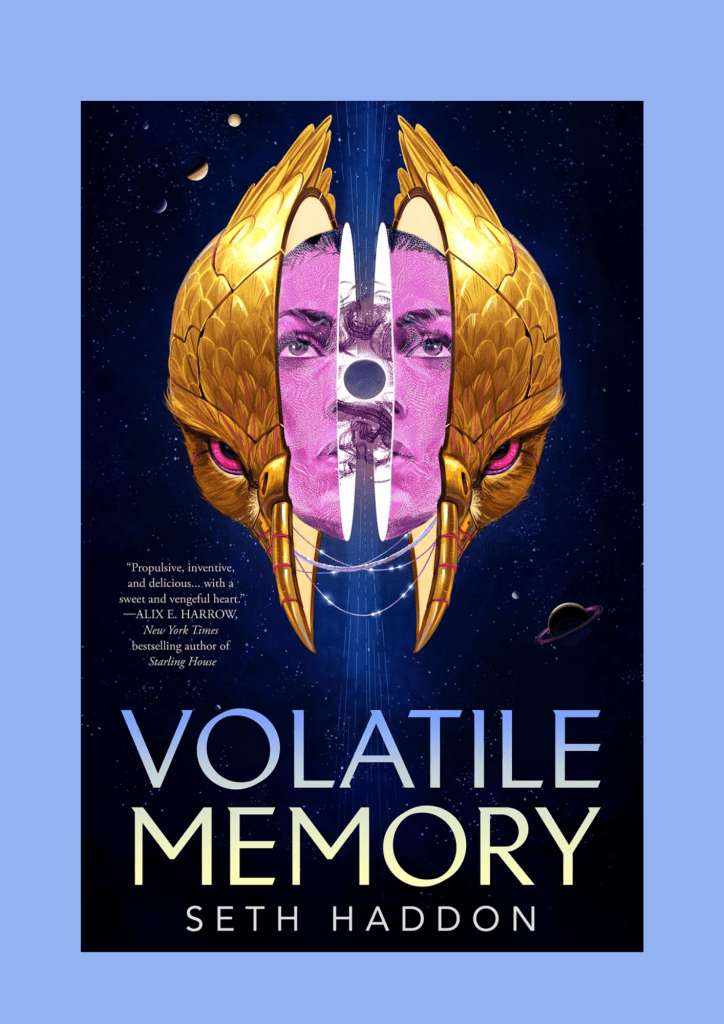
Volatile Memory by Seth Haddon

When she happens upon a dead body with a Hawk mask after following a beacon, scavenger Wylla knows it could be the thing that saves her, from the payout alone. What she doesn’t know is the mask is alive, retaining the memory of the wearer long after their death. That person is Sable, whose consciousness has been transferred over to the mask but she doesn’t remember anything before Wylla, just flashes of a life previously lived. With an advanced technology now in her grasp, Wylla must decide to stay in the shadows or take a stand against the group that resulted in Sable’s death and revenge of course is the sweeter option. Volatile Memory is exemplary science-fiction and the fact that it is a novella is just a bonus. Traversing deep into the boundaries of identity and body autonomy, Seth Haddon’s Volatile Memory feels both cathartic and startlingly relevant. Wylla, our main character, has clawed her way to her identity, shaping a body that belongs to her in a world that controls every aspect of your identity down to your genetic code. Accepting her trans identity goes against everything she has been told to be, and yet Wylla has done everything to live fully as herself. Haddon contrasts this through Sable, a woman whose physical body was violently ripped away from her to become housed within a mask. Yet she is so much more than a mere mask. Told entirely in second person, this novella floored me with the sheer love wrapped up in the recounting of events, and that is all from Sable. Volatile Memory is an exhilarating window into survival and existence, whether it can transcend the physical body to become something unforeseen, but no less powerful.

Buy a Copy:

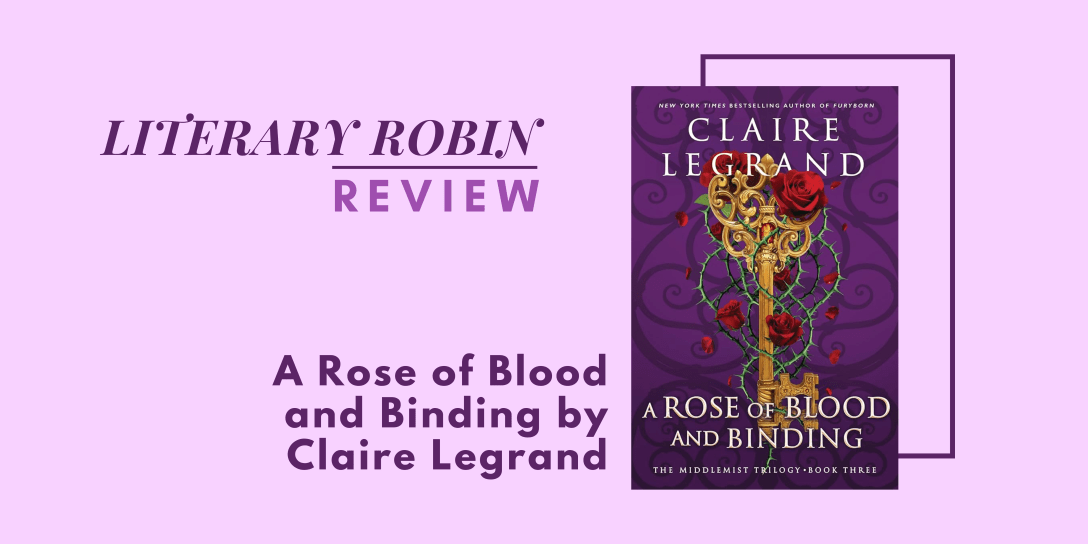
Review: A Rose of Blood and Binding by Claire Legrand

Please note this review contains spoilers for the former books in this series, A Crown of Ivy and Glass & A Song of Ash and Moonlight, and contains references to some of the events in this sequel. Read with caution.  

Rating: 5 out of 5.

As the Middlemist weakens—the protective barrier between the new country and the old, so have olden creatures found their way into Edyn. The last line of defense is the Order of the Rose, a sect of female warriors tasked with protecting the Middlemist for generations. Mara Ashbourne has been bound to the Middlemist for twelve long years, ever separated from her family and built to be a weapon in the hands of its Warden—the famed leader of the Order who can call her Roses to battle through the bond they share, transforming them into a mix of warrior and beast. Though monsters run rampant through Edyn, it is the awakened gods who present a far greater threat. Hunted by a vindictive god named Kilraith intent on destroying them and harnessing a war on humanity, these awakened gods are the next stage of Kilraith’s assault. As demigod daughters to the goddess Kerezen, Mara and her sisters are the ones tasked with hunting them down before he can. When a sect of scholars arrive in Rosewarren to provide aid, Mara faces the rakish, fiercely intelligent Gareth Fontaine, librarian and close friend to her sister. Cloaked in a facade of confidence, Gareth’s experiences speak to a greater sorrow that mirrors her own, and he decides to help her in her task. Torn between protecting those she loves and her alliance to the Warden, while a deeper connection builds with Gareth, Mara toils to bridge two worlds before the Middlemist falls and with it herself, bound to its fate.

Regency style romance in a fantasy world with awakened gods, cursed artifacts, rival families, and a legendary group of female warriors tasked with protecting the barrier between realms are integral to Claire Legrand’s Middlemist Trilogy. A true romantic fantasy jewel, A Rose of Blood and Binding is this trilogy’s final battlecry as the middle Ashbourne sister Mara and the delightfully rakish librarian Gareth Fontaine get up to shenanigans while on the path to uncovering the cursed objects of a violent God. Legrand has an innate talent for the middling spaces—where romance meets fantasy, fantasy meets historical, and all three intertwine in a potent atmosphere in her Middlemist trilogy. The stakes are unquestionably elevated after the events concluding A Song of Ash and Moonlight, in which our crew destroyed the human embodiment of a god alongside Kilraith’s cursed object. But who better to pick up the unbearable weight of it all than a middle sister am I right? Bound to the Middlemist and taken far from home, Mara Ashbourne is our slightly broody, sometimes avian, and decidedly bisexual heroine tasked with saving the day and bringing this series to a close (no pressure though). As the Middlemist weakens and our characters stand united, Claire Legrand evinces that it is our bonds that far outweigh any evil, and in fact they may be the very thing that saves us end-all. 

Something about the warrior scholar pairing is really working overtime this year and A Rose of Blood and Binding is no different in that regard. Maybe it’s the contrast between blood and violence of the warrior and the buttoned up bespectacled hero thrust into the action, doomed to come out the other side irrevocably changed. Either way I am into it. With crumbs for her future romance arcs scattered across the narratives of her past novels, imagine my surprise in the reveal that Mara Ashbourne would find romance with our resident librarian Gareth Fontaine. Up until this point, Mara was an enigma, a presence flitting in and out of the narrative, followed by an aura of immense sorrow. That and undeniable middle sister energy. I was elated for all things Mara in this finale and Legrand does not disappoint. A Rose of Blood and Binding sees the barriers of the Middlemist weaken and Mara in the center of it all, to confront the danger or succumb to the unbearable weight of her charge. Soldiering the burden meant for her younger sister twelve years past, Mara is for all the middle sisters out there, speaking to those who bear the weight so that others won’t have to do the same. Burdened by duty and unable to see a way out, this finale is as much about bringing an end to Kilraith’s assault as it is liberating Mara with a life of her own choosing.

Behind every fearsome woman with a sword (who can also turn into a bird) is a bespectacled scholar who will do anything to save her. But first, a reluctant alliance must emerge. To establish this dynamic between Gareth and Mara, Claire Legrand pulls a classic historical romance move: a ball where our two characters come face to face. The vibes are anything but light (I mean the Middlemist is breaking apart and everyone is stressed), the flirtatiousness is dialed up to the max, and Mara doesn’t really want anything to do with Gareth—who is nothing more than a prickling annoyance in her side. It was at this moment that I was entirely invested. Legrand has always been adept at her character dynamics, because beneath their facades there is always something more. Mara and Gareth seem to have absolutely nothing in common past a desire to solve their godly problem, but it soon becomes evident just how similar they really are. Beyond their fragile alliance to hunt down the cursed objects of Kilraith, Gareth and Mara are haunted by past traumas and lingering depression—Gareth after surviving the horrors of Mhorghast where his body was used against him, and Mara through her continued isolation and loss of autonomy at the hands of the Warden. Legrand juxtaposes this struggle with autonomy and the conflict of perseverance between Mara and Gareth both and it is as essential to their romance as it is to themselves.

Bewildering, stoic Mara faces down olden creatures, gods, and her corrupted mentor, finding solace with an opinionated scholar and notorious flirt while on the path to destroy an ancient god. In Claire Legrand’s, A Rose of Blood and Binding, her cast of characters confront an ever fracturing world as they attempt to bridge their places within society with their link to the gods—before Kilraith descends upon them and lays waste to all they hold dear. A Rose of Blood and Binding is certainly the darkest of the three novels, set in the time after freeing their companions from Mhorghast and destroying another of Kilraith’s anchors. Legrand contrasts these darker themes against a budding romance between Mara and Gareth, and continued moments of sisterhood from our core trio. But where this third novel particularly excels is in its representation of depression, centered around Mara and Gareth both. The struggle with mental health and depression is an irrefutable reality for both of these characters and is a large part of this final journey into the Middlemist where they must reach past their traumas to claim a life side by side. Mara and Gareth, while initially an unlikely pair, find comfort, commonality, and finally romance together. This green flag of a man who loves books and appreciates a good stew is perfectly paired against a brooding warrior used to soldiering everything alone. A romance filled with all the tension you’d expect from such a pair and the angst Legrand is known for. Dark, hopeful, and irrefutably romantic, A Rose of Blood and Binding is an unparalleled fantasy romance with a beating, yearning center. A true delight from start to finish, and a series to hold close for all time.

Thank you to Netgalley and the publisher for providing me with an advance review copy.
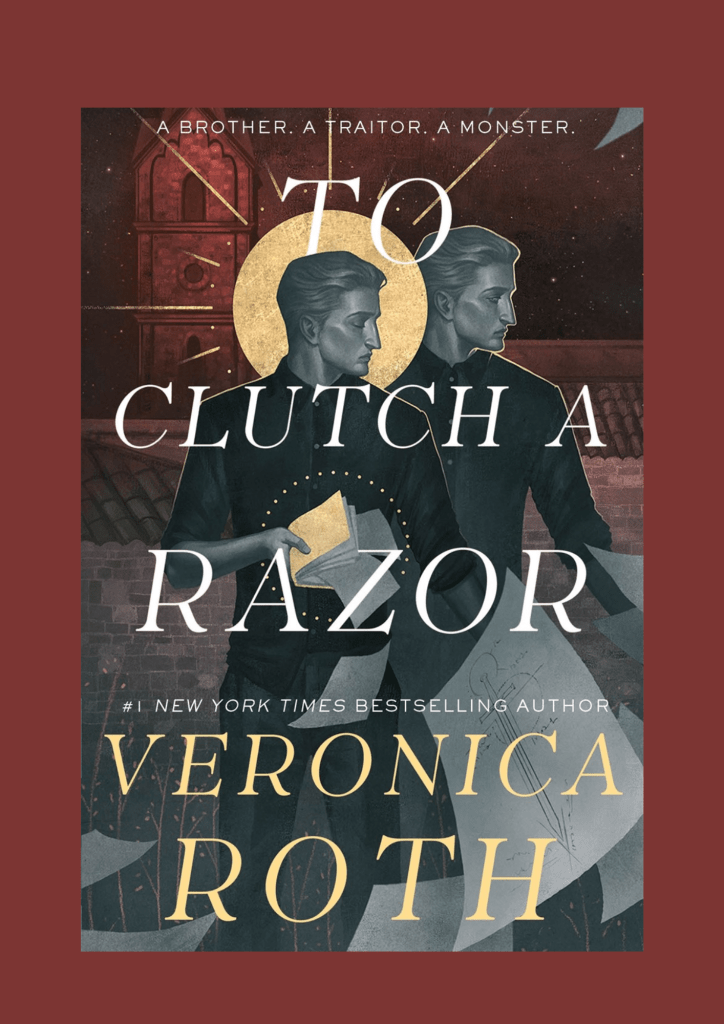
Trigger warnings: discussions of self harm, suicidal ideation (both passive and active), depression, torture, blood, death, murder

Preorder a Copy – Out 24th February

Review: The Last Soul Among Wolves by Melissa Caruso

Rating: 5 out of 5.

Months after surviving a deadly New Years Eve party, Kembral Thorn is tired. All she wants is to be home with her newborn daughter and to have time to romance her former rival turned girlfriend, Rika Nonesuch. But as a member of the Hounds she is called to weigh in on an important will reading by a friend in dire need. At a decrepit mansion on an island accessed only by low tide a wealthy matriarch has died, leaving behind an unlikely inheritance. Brought to the island to witness, Kembral comes face to face with an unlikely group—her friends from childhood, most of whom she has not seen since, and all of whom are the potential inheritors. When the will is read, a violent inheritance is revealed concerning three relics, a ledger, and a coveted wish gained by crossing off all the people in the ledger until there is a lone victor. With no choice but to solve the case before her friends are all killed, Kembral finds herself back in the action and at her side, her girlfriend and rival, Rika Nonesuch. But uncovering the mysterious lantern of souls and the wolf who guards it will require Kembral to return into the dangerous echoes only a few months after naming the Crux year. Her blood will be a beacon to all beings across the echoes, but getting ahead of the machinations of an immortal foe will require scheming and quite a bit of danger of their own, if they are to survive.

Melissa Caruso’s, The Echo Archives returns with The Last Soul Among Wolves, commencing a mystery involving cursed relics, rival sapphic agents, and empyric beings, across multiple layers of reality. After the absolute triumph that was The Last Hour Between Worlds I wondered how this sequel would fare against such an exemplary series debut. A locked room murder mystery across a repeated hour of New Years Eve is hard to beat. Yet Caruso holds true to her characters, introducing a new layer to an already compact narrative and another impossible mystery to solve. A new locked room mystery of sorts is at play in The Last Soul Among Wolves, with a sequestered manor and a race to track down a wolf and a lantern of souls before time runs out and everyone is killed. Characters Kembral Thorne and Rika Nonesuch find their balance in this second installment, seasoned to the lower echoes and the conspiracies present at all levels of reality. But true to Caruso’s style, this mystery is anything but typical and as new elements are revealed they are forced to compromise and take unconventional steps forward. For anyone loving a well plotted mystery cloaked in numerous realities ever increasing in weirdness, The Echo Archives has this formula locked down. The romance is romancing, the mystery is uncanny, and all of it aligns a perfect finale like dominos ready to fall.

The Last Soul Among Wolves is just: two former rivals now girlfriends finding themselves the victim of yet another locked room murder mystery. Where solving said mystery is contingent on them returning to the alternate layers of reality only two months since they almost died. The Echo Archives would not be nearly as strong as it is without its solid character work. From our main perspective Kembral Thorne—Hound and mother, to her enigmatic rival: Rika Nonesuch, our potential murder victims, and a babysitting Elder dragon, Caruso has it all in hand. Alongside these individual character arcs, what makes this sequel so great is the unveiling of just how much the first novel laid the foundation for the second. Taking fruition in the depths of reality with an empyrean—the most powerful of all Echo beings— intent on control at any cost, The Last Soul Among Wolves reveals its holdings lie prior to the events of this novel. Caruso’s twists always land with the finesse of a blink step and unsettling as the very fabric of reality shifts and resettles. Digging deeper into the empyreans, the echoes, and the heartwarming relationship between Kembral and Rika, this sequel reinforces this unique fantasy world and all its idiosyncrasies. Even with new characters to discover the heart and soul of the Echo Archives remain our disparate but remarkably compatible duo finding romance between the danger. Often with no regard for the danger itself.

The intersection of mystery and fantasy is being well supplied this year and Melissa Caruso is the one leading the charge with her Echo Archives trilogy. The Last Soul Among Wolves is second in a line of extraordinary fantasy mysteries featuring unconventional characters at the helm and bonkers plotting (in the best kind of way). A little bit of Knives Out, an abundance of murder and contrasting realities, and you’ll find there is nothing quite like this mystery series. Though connected to the first novel, The Last Soul Among Wolves is an entirely new pitch than its predecessor. For one, we’re no longer stuck at a New Years Eve party for an entire book, but instead a will reading hosted in a mansion with cursed heirlooms and a collection of mismatched personalities stuck inside the manor until the case is solved. After an entire book orienting us to the Echoes and the dangers present at the lower levels of reality, it’s refreshing to get more insight into the runnings of this world and the inter Guild politics. A big part of this sequel is reconciliation for Kembral and her friends from childhood, and Rika and Kembral pursuing a romantic relationship while staying true to their Guild alliances. It’s a tough line to straddle and Caruso makes sure to tie it to some of her larger revelations. With The Last Soul Among Wolves the main word that comes to mind is “exceptional.” It’s the kind of book to venture into boldly and enjoy recklessly like all the best adventures are.

Thank you to Netgalley and the publisher for providing me with an advance review copy.
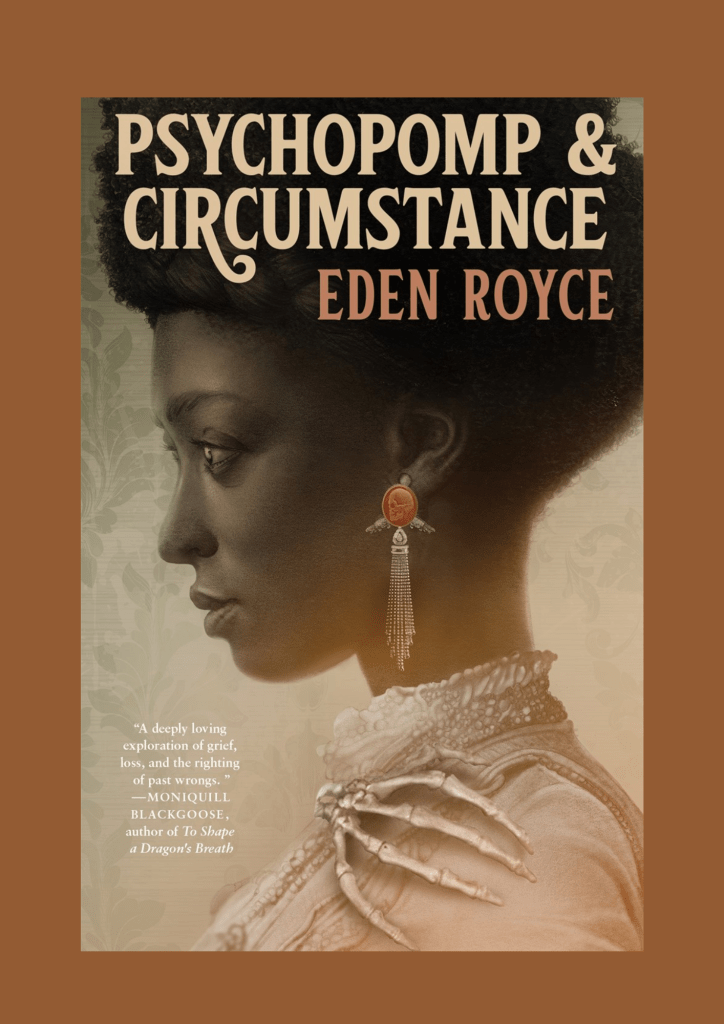
Trigger warnings: death, murder, blood, grief

Buy a Copy: