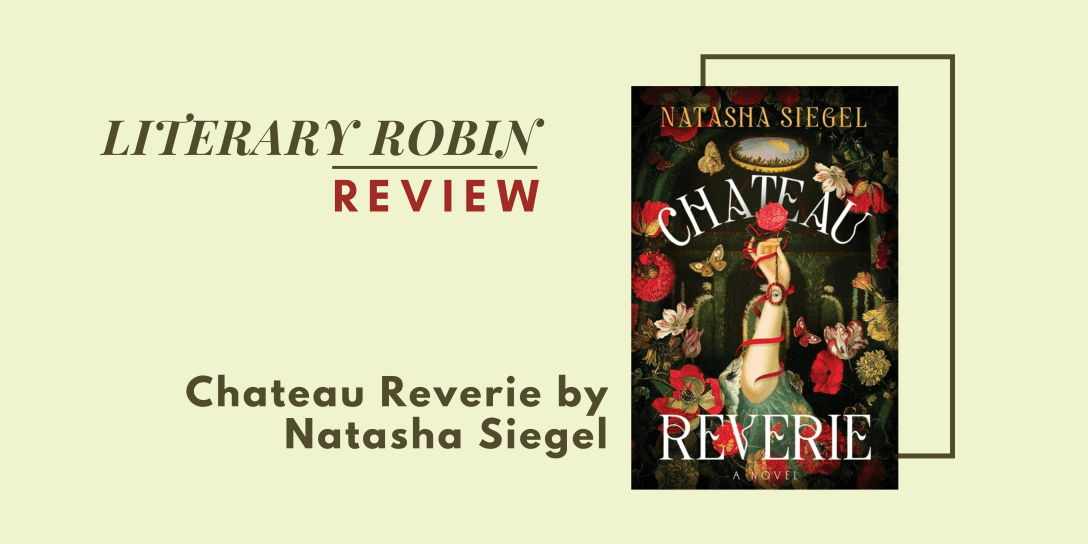
Review: Chateau Reverie by Natasha Siegel

Rating: 4.5 out of 5.

When the invitation arrives, Genevieve de Vienne does not know what compels her to accept. The invitation only asks for her to write upon it her heart’s desire before setting it alight. For Genevieve, there is nothing she desires more than to forget Claire Marchard, her former companion and lover lost to violence. For Leander Sterne, there is nothing he desires more than his liberty. To have a chance at their wishes being granted, both must attend the mysterious Reverie and Son’s Auction of Secrets—a choice made in setting fire to their desires, answering the alluring call of the Chateau Reverie. Arriving at the Chateau, Genevieve remembers nothing that came before the burning of the letter. Surrounded by others who have journeyed to the chateau for its powers, Genevieve is soon drawn close to one guest in particular, Leander Sterne. Hardened by a past that remains a mystery, Leander will do anything to win the game and secure his freedom. Yet his continued rise in the competition will require his deception over the woman who threatens his heart. The chateau cannot allow Genevieve and Leander to triumph together, for their desires for freedom and forgetting are in direct conflict, and neither of them wished for love in this exchange. To win will mean achieving a hollow goal, condemning the other to a far worse fate.

Natasha Siegel returns with another magical journey of star crossed love, fate, and the desperation which drives humans to bargain for their desires. Enter the Chateau Reverie, a place and a power that casts its nets upon the lost souls yearning to leave something behind, or gain anew. Where secrets are the currency and love has no place. Genevieve de Vienne desires to forget, Leander Sterne desires to remember, but neither party accounted for a love that would have them risk even their own freedom. Natasha Siegel has fully embraced the kind of historical speculative novels that make me go feral. It’s not enough to deliver a well rounded interrogation on humanity, on a period of history, she has to throw in a romance that had me clawing up the walls. Chateau Reverie is Siegel’s take on a star-crossed love story, set in the remaining years of the French Revolution on a Chateau out of time. Behind the walls of the Chateau Reverie, memory and power call out to the helpless to participate in an auction of secrets, where secrets are exchanged for their greatest desires. Grief and liberty are the lure to our lovers Genevieve and Leander, fated to intersect and be torn between want and sacrifice. Natasha Siegel’s compelling voice lends meaning to memory—the choices that define our past, and determine our future. Chateau Reverie is a twisted standalone of epic romance and tragic acts, lending weight to our shared humanity and love’s hand in surmounting even our darkest moments.

There is a complexity to Chateau Reverie that yearns to be uncovered from the novel’s first breaths. Siegel understands the power in the prologue, those glimpses to that which drives our characters to set an invitation aflame and travel the long journey to the Chateau. Once there, a chance meeting on the estate’s sprawling grounds introduces protagonists Genevieve to Leader, opposites in desires they may be, but inextricably drawn to one another. Between uncovering the mysteries of the auction and their fellow attendants, these two are yearning with a capital Y—a feat considering this novel’s condensed timeline, but another testament to Siegel’s powers; she’s going to bring on the yearn and you will feel it. The dynamic between these two is one that sinks in its claws (much akin to the chateau itself). Though both haunted by the past, Genevieve and Leander could not be more different in temperament, and their misperception to one another drives forward most of the tension in the first half of the novel. I fell in love with Leander when he woke up in a shallow grave and said no but it’s my fault for attempting to get some sleep. And Genevieve, who in many ways cloaks herself in pretense, is one you cannot help but love and root for—for her to live life in the light and for her to forgive herself for what she had to do to survive. Anyone who loves a good character driven tale will hunger little within the confines of Siegel’s Chateau. As this is me, oh did I feast.

File this novel under: this house is alive. And it’s preying on us. Chateau Reverie is like a doll house where every room uncovers some small trinket of humanity, the inner psyche of our characters, and the conundrum of our existence. This chateau holds memories of days long past and its glittering atmosphere and ornament is a facade to darker truths. These things torment the reader as we are led deeper into its cavernous underbelly and grapple with reality: is it a dream or little more than a facade. The tragedy of the lovers Genevieve and Leander feels pertinent here. Though love can strengthen us to surmount our pasts, is it something that is enough for us to cast off that which restrains us. Can we have freedom if we have to cast love aside and condemn another to torment?? Wandering the maze through Chateau Reverie’s heart, Siegel pushes Leander and Genevieve to expose the truths which hold them back from stepping forward and leaving behind the past. There’s a catharsis and a grief here, and in Lady Reverie, we see how humanity is a feeding ground for higher powers to feast upon. Dreams, regrets, thoughtless desires, it all finds a home within the boundaries of the chateau. It is up to our duo to reach for a future beyond their myth, the ending for a story long planned.

Chateau Reverie stretches out its hands and calls upon an age-old longing, one that takes hold of the reader as we are led further and further through its deceptive halls. One thing about Natasha Siegel: atmosphere is everything and this novel practically glimmers in it. The rococo design, chateau setting, and elegant attire for this period are an immersive surrounding for Siegel to enmesh the reader within. This excess haunts the narrative, a reminder of the pain hiding beneath this period and to our characters, who fight to move beyond pain and suffering. One of my favorite parts of this story is how easy it is to fall prey to a single narrative, allowing us to believe we have no choice. That single narrative can be confining ourselves in the past and the things that have been done to us. Though our characters are cornered by the deceptive nature of the chateau, there is always a way out, one they must uncover and fight for. Chateau Reverie is another historical fantasy legend from one of my favorite emerging fantasy voices. Look no future for standalones that pack a kick and provide that feral style of yearning. Natasha Siegel is never not making me lose my mind over a romance, and with two leads determined to sacrifice themselves for the other, this was never not going to land with me. Siegel’s Chateau Reverie stands as a testament of humanity’s desire to gain—certainly—but moreover, to follow our inner lantern and leave behind the fear that we could drown. To follow the lantern anyway.

Thank you to Edelweiss and the publisher for providing an early review copy.

Trigger warnings: violence, death, war, drowning, dead animals, suicide, suicidal ideation
Preorder a Copy – Out 27th October

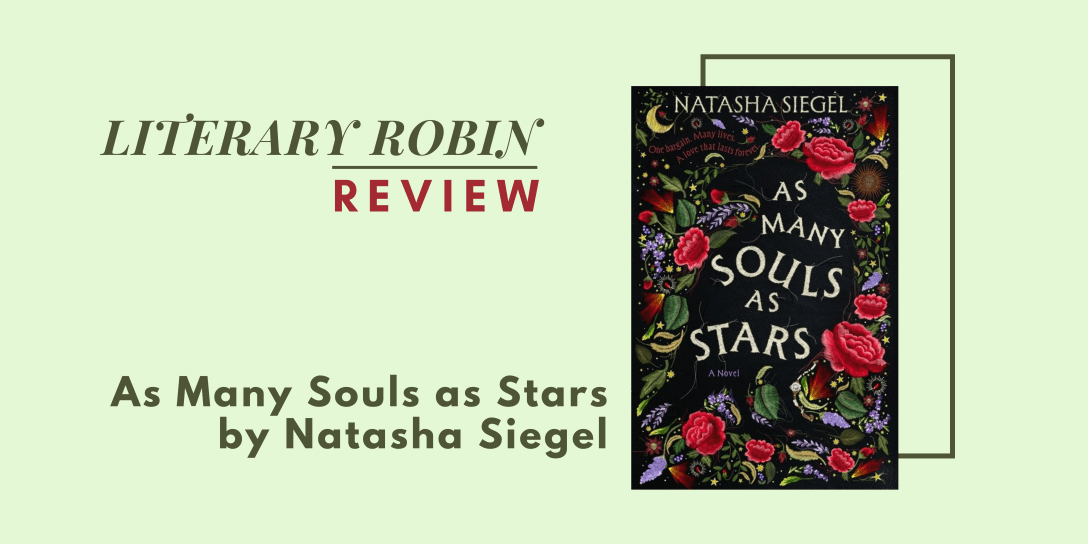
Review: As Many Souls as Stars by Natasha Siegel

Rating: 5 out of 5.

Cybil Harding is cursed. The latest in a string of firstborn daughters fated to bring an end to the Harding family line, Cybil was not meant to live beyond infancy. Against all odds, Cybil survived. Raised in the isolated Harding Hall estate, Cybil is all aware of her strangeness, the various deaths in childhood she feels she orchestrated, the flames and shadows leaning towards her as if in prayer, and the whisperings of the servants within its halls. Miriam Richter is a creature of hunger. A mere shadow in human cloaking created long ago for dark purposes, Miriam must subsist off of human souls, and never has she seen a soul as alluring as Cybil’s. Souls have to be freely given however, and Cybil is not inclined to relinquish her soul—not even for the chance at removing her curse. But when an accusation of witchcraft leaves Cybil dead and Harding Hall in flames, all she wants is another chance at the life cruelly stolen from her. Thus the two bargain. Cybil will get as many years back as she lived and in that time must seek a cure for her curse, or her soul now magnified by her reincarnation will be Miriam’s to collect. Across the lifetimes, Miriam hunts Cybil intent on taking what’s hers, but the centuries have only emboldened Cybil to retain her soul, even if it means she must at first offer up her heart and what little remains of her humanity.

Drawing together Faustian bargains, gothic splendor, and reincarnation across three distinct periods of English history, As Many Souls as Stars is a historical novel for the ages and Natasha Siegel’s masterpiece. A witch desperate for survival bargains away her soul, a demon endlessly hungering for souls discovers the brightest, and both will be ruined in their association by journeys end. The Faustian bargain is not a new concept, not in the slightest, so to stake claim on such a tale is to promise something inventive and unique in the telling. In As Many Souls as Stars, Natasha Siegel ingeniously twists the Faustian bargain into a lesbian game of cat and mouse spanning multiple centuries and incarnations as an immortal and a witch engage in a toxic romance tinged with obsession. Cybil Harding and Miriam Richter, witch and demoness, hunger both—for love, for souls, and for the continuance of their survival. Drawn into a demonic bargain to suit their purposes, neither intends to lose the parts of themselves they believed intrinsic, nor ill-fated love taking flight. Questioning fate and personhood, Natasha Siegel’s As Many Souls as Stars is a tangled dance of violence, hunger, and destructive romance, in everlasting opposition as misguided bargains can ever be.

As Many Souls as Stars is a dark, resplendent jewel immersed in the gothic tradition and draped in midnight hungers. Demonic bargains gone awry, witchcraft, and obsession mark the beginnings of this expansive saga in which Natasha Siegel mercilessly binds a demon to a young witch clawing herself back from the dead at the cost of her soul. Where some novels take time to settle with you, As Many Souls as Stars is decidedly not one of them. A prologue illuminating the origins of our demon, and the opening lines “Cybil Harding was born on Christmas Eve, 1576, under inauspicious stars” immediately signaled to me Natasha Siegel’s storytelling caliber and exactly what was in store with this extraordinary tale. Siegel does not hold off a whit in building up her gothic romance that leans heavy on the enemies to lovers side of things. It’s been ages since I read a true enemies to lovers’ romance, something that threads the needle in between love and hate with a capable hand. As Many Souls as Stars takes that challenge and gives a lesbian relationship overflowing with want and drawn towards destruction, where the star-crossed love of a witch and demon comes second to their other desires.

I love a story traversing multiple genres, and As Many Souls as Stars takes up a bold space between historical fiction, fantasy, and gothic romance. Natasha Siegel has a firm hold on her narrative, depicting the three reincarnations of her character Cybil Harding and glimpsing Miriam’s interludes at key moments of history. Traveling the centuries, Siegel orchestrates the dance between these two fickle beings and their decline. So slow it could even be unnoticeable Natasha Siegel begins to track Harding’s descent into the loss of her humanity—in consequence to what was done to her and the bargain she made, and Miriam’s inexorable transformation towards it, drawing to her unmaking. The love brimming with hatred, the devotion that leads to violence, these are all things that appear entirely contrary, but Siegel proves in essence belongs to Cybil and Miriam’s volatile love. Cybil and Miriam clash and retreat across the years, a battle of wills neither will concede and made all the more precarious by their developing romance. I was immediately struck by their conviction, Cybil’s desire to survive and take back her life and Miriam’s commitment to her demonic ways. Misguided perhaps, but essential for their conflict and the incredible transformation brought about by its end.

In all of Cybil’s reincarnations as she is hunted by Miriam, Siegel explores the dichotomy between love and hate and its natural end—with only one of them holding the knife and the other destroyed. There’s always been hatred seething beneath Cybil and Miriam’s interactions but that is essential to the love they find together. Destructive love can be freeing in a way, and for Cybil it tethers her to a life of her own design, one she will fight for at any cost. Covering three lifetimes of Cybil reincarnating, Siegel questions not just if the cycle can be broken but if it can be accomplished without Cybil and Miriam as each other’s undoing. The natural end to any cat and mouse game is when one is caught, and Natasha Siegel gives us that with her fervent final act upon a ship headed towards New York. The setting of a ship with the salt spray and the incessant rocking was fitting, with Miriam and Cybil completely cut off from their resources and nowhere to escape. Miriam and Cybil were always going to destroy each other, we’re told that from the start, yet witnessing that destruction play out firsthand is something else entirely. I found my screams well matched with that penultimate scene on the crows nest, but just as shocking was Siegel’s life-altering final twist that cleverly flipped the script and sent me reeling.

As dangerous as a bargain and as haunting as any loss, As Many Souls as Stars is about hunger in all shapes and forms, and the risk in losing ourselves as we chase it. Sometimes you read a novel that feels torn from the very fabric of your soul, and how could this not be that. We’ve got sentient shadows, a lesbian demon who can turn into a raven (caw caw), gothic locales, and an enemies to lovers tale with a wonderfully unhinged ending. Basically Robin catnip. Natasha Siegel’s gothic historical fantasy echoes with female rage and a wild and unrestrained magic in the hands of an isolated witch and sardonic demon caught up in a battle of wits. Fashioning such a saga is an immense challenge, and it’s felt in every overwhelming detail of this novel. Immortals being humanized! Hungering for the very thing that can destroy you! Things coming full circle! This novel has all that and more. The singular pieces that come together to form this story are striking all on their own but together they have ruined me for all other books. As Many Souls as Stars is so many things, but it’s largely a story about what we’re willing to give up for our autonomy and where we find the power to take it. All other gothic fiction aspires to be like this and I will continue to be haunted in its absence.

Thank you for Netgalley and the publisher for providing me with an advance review copy.

Trigger warnings: blood, death, death of a child, gore, murder, suicidal ideation, misogyny, homophobia,

Preorder a Copy – Out 25th November