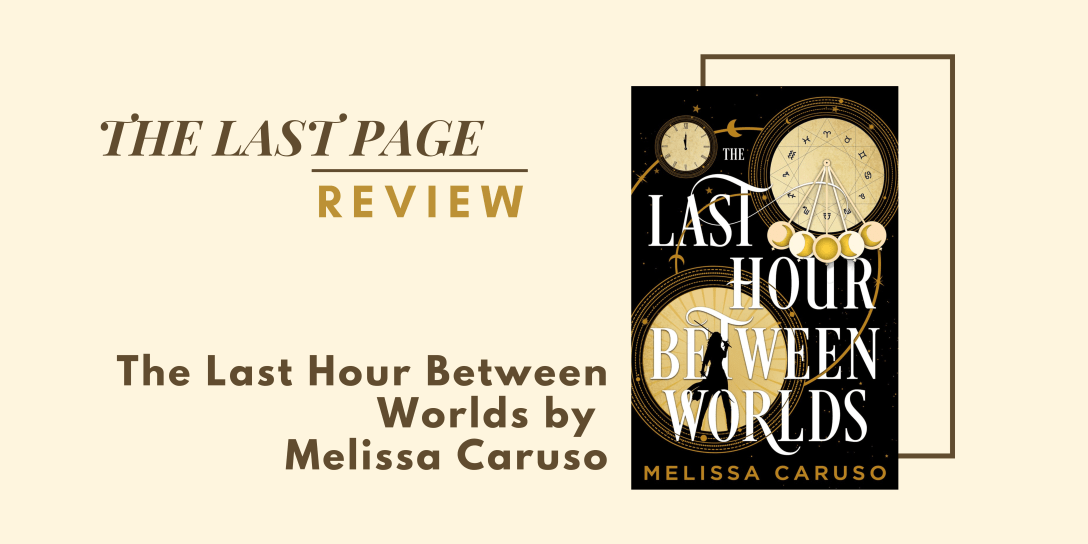
Review: The Last Hour Between Worlds by Melissa Caruso

Rating: 5 out of 5.

Kembral Thorne never imagined that a turn of the new year party, her first outing since childbirth, would throw her back into the action she had been desperately trying to avoid. A member of the Guild of Hounds, Kembral’s job is to leave the prime reality and enter echoes, layers of reality beneath our own, to rescue those unluckily enough to fall through. Just as the clock strikes nine Kembral bears witness to a poisoning that leaves most of the party guests dead, but before she has time to comprehend the murders she and everyone at the manor enter an echo, one plane of reality beneath their own. Everyone is alive and well, but unable to tell they are in an echo, all except Kembral. The only other privy to this sinister shift is Rika Nonesuch, notorious thief, and master illusionist, Kembral’s rival and greatest mistake. Rika’s skills are undeniable, and together they piece that an echo relic is to blame for sending them down from the prime reality, the grandfather clock ringing out the hour. The first echo is only the beginning. At the end of each hour, a horrific murder takes place by strange figures just before they are sent down into the next plane of reality, and time resets. Growing ever enlightened to their strange circumstances, Kembral and Rika will risk everything, even their uncertain future together, to unmask the real players and reset their world before their violent reality turns permanent.

A turn of the New Year party brings on the intrigue and mystery in The Last Hour Between Worlds – a startlingly layered series debut that disentangles a campy, sinister locked room murder mystery spanning twelve different layers of reality. Featuring a postpartum agent on leave trying to stop the murders and a sapphic cat-and-mouse game between two rivals who team up to solve the case, Caruso’s latest is an ambitious cocktail with ever-changing flavors, all of which remained entrenched in my memory long after I finished reading. Caruso plunges her characters into alternate realities that grow more and more bizarre, as she untangles her complicated web of humans, echoes, and empyreans playing a dangerous game to decide the fate of the upcoming year. With twelve new realities to wade through before the game is up, The Last Hours Between Worlds introduces a new kind of fantasy mystery that completely rewrites the possibilities of its genres and the types of protagonists featured at their center. 

Wading into Melissa Caruso’s fantasy murder mystery set over twelve warped realities folding into alignment was as mind-bending as these phantasmagorical realities themselves. Set on the eve of The Crux Year, the party brought into focus could not be more unusual, apparent by the bloodshed commencing on the prime reality and dragging down beneath the echoes. As different planes of reality converge whoever makes a kill on that reality binds it to the one preceding, and the person with the most blood spilled at the twelfth and final layer of reality can dictate the outcome of the new year. Kembral Thorne, mother and fierce member of the Guild of Hounds steps into the role of unmasking the true players of the game, from the iridescent beetles swarming the house, to the mysterious masked attendants, and a horned being of pure chaos who shows up to doll out violence according to birth moon. Not all players are inhuman, from the corrupt politician directly responsible for kidnapping Echoborne children, to his spirited adversary, or the host of the evening who willingly brought the echo relic into her home – the clock driving them ever deeper into the echo planes. Superimposing a series of ever-bending realities, Caruso manages to unveil her true purpose as her characters encounter increasing violence and investigate the corruption at the heart of their evening and the motivations of all.

The Last Hour Between Worlds is a revelation in so many different ways, but largely in its central protagonist Kembral – a new mom encountering the challenge of balancing her role in motherhood and her career within the Guild of Hounds. Both are fulfilling in their own unique way but marrying the two seems impossible. Her current situation seems to prove that all the more. As she struggles to balance her diverging worlds Kembral is quite literally thrust down into ever bizarre imitations of her world where she steps back into her former shoes and learns just how she can find harmony. Like layers of a cake all with astonishingly different flavors, the echoes shift – one entangling the house in jungle vines, another an insipid rot, to a lake of blood running throughout the house lapping at our characters’ heels. Caruso attaches these layers to her mystery and everything revealed within the repeat of a single hour. Staving off reaching the twelfth and final layer, Kembral uses her talents as a Hound to untangle the truth connected to the heart of the Crux Year and the relationship with her rival Rika. The reveals to the motivations of our cast and to the true players of the game were completely illuminating, as humanity becomes a playing field and our characters puppets for the machinations of empyreans and the echo beings beneath the prime reality.

Melissa Caruso has left me completely stupefied by this inventive series debut. Playing on the traditions of Agatha Christie and the investigative duo, but integrating concepts of the multiverse and centering queer characters, Caruso puts her own stamp on the classic whodunit and the fantasy mystery crossover. Impressive in its magnitude, The Last Hour Between Worlds is a groundbreaking beginning emboldened by what is sure to be a boundary-spanning series. I’m so impressed by the twists that didn’t lose their punch and how deeply layered this managed to be. I was put through all the emotions from start to finish and though I can’t easily encapsulate the full experience of reading The Last Hour Between Worlds, it is truly brilliant and deserves to be read by everyone this November and beyond.

Thank you to Netgalley and the publisher for providing this advance copy in exchange for an honest review.

Trigger warnings: blood, murder, death
Buy a Copy:

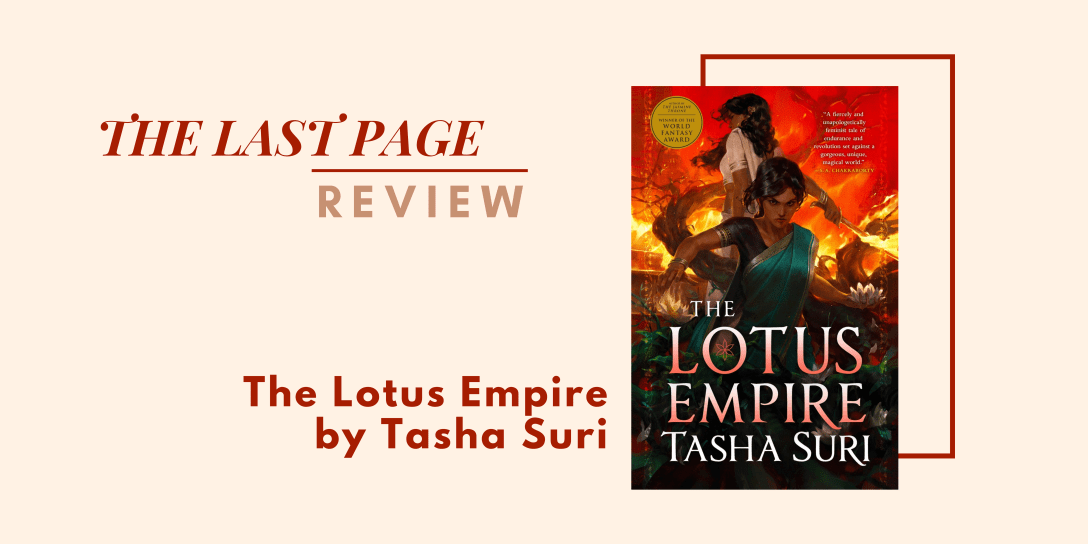
Review: The Lotus Empire by Tasha Suri

Rating: 5 out of 5.

Malini has fulfilled the prophecy of the nameless gods, crowning herself empress of Parijatdvipa. Yet she will not take it further from the throne to the pyre, decrying the unnecessary sacrifice of the women who burned before her. Back in Ahiranya, war looms. After thrice surviving the deathless waters, Priya thought there would be no consequences for the power simmering beneath her skin. Driven to betray her love, Priya walks a dangerous path against the Yaksa who unveil a plot that will further transform her world. Beneath the deathless waters lies the powerful Yaksa, Mani Ara, who instills faith in Priya, but whose support comes with an irreversible consequence, Priya herself. Led far away from her sister and home, Bhumika is without her memories, her connection to her powers and the Yaksa irrevocably severed. On a path to learn how to destroy their subjugators, Bhumika and Jeevan evade their pursuers by hiding out in small towns desperate to learn information that could turn the tide in this war. Set against an enemy ancient and powerful, three women torn apart by fate and their respective roles must reconcile or see the destruction of their kingdoms and the entire world.

The Lotus Empire is the third and final installment in the Burning Kingdoms trilogy, tethering three women across kingdoms against a grave threat that will further transform their already unstable world. Tasha Suri sets Parijatdvipa alight with further consequences as Malini, now empress, stands against the priesthood and taking to the pyre – the ultimate sacrifice, and Priya and Bhumika rage against the control of the Yaksa who have now taken over Ahiranya with sights set beyond its borders. Though old enemies have been ousted, a new fight is on the rise. Drawn outward like a flower in bloom, The Lotus Empire unfolds a deadly approach to the war with the Yaksa and the true cost of defining the future of an empire. Tasha Suri leaves no hold barred in this astounding series finale that tests the depth of our characters’ loyalty and the paths they will walk to reverse the hold of an unknowable enemy on their world. Its breadth of perspective and world scope increasing steadily outward as the stakes only intensify, The Lotus Empire challenges not just its former two books but how one rounds out an epic fantasy trilogy. 

Before I sank into the treacherous waters of The Lotus Empire I decided to double back and read through the Burning Kingdoms trilogy in its entirety – quite possibly the best decision I could have made considering just how much I had forgotten from my initial read-through of this series. Witnessing the seeds of the plot unfurling over books one to three was so rewarding and made this finale all the better. The Lotus Empire brings more to the world stage with our three characters scattered to the winds, but slowly unifying against the fight to come. The character arcs given to Priya, Malini, and Bhumika across this final act are my favorite in the trilogy – Malini, desperate to hold fast to her position as empress and facing an alien enemy, Priya at a crossroads with a power that could save her people that comes at the expense of her autonomy, and Bhumika without her core memories on a path to destroy the Yaksa. The way these three narratives intersect and twine throughout the book is sheer perfection and it’s some of Suri’s best plotting so far. Tasha Suri uncovers the depth of the deception of the Yaksa, promising a better world that can only be accomplished through bloodshed and subjugation. Through Priya’s experiences and those working to find a weapon to use against them, The Lotus Empire elevates the history of the Yaksa and the Age of Flowers. Some of my favorite parts of this series have been the intricate histories and cultures, the past hidden from view, and that being unveiled after two books was just nothing short of spectacular. The revelation that the Yaksa fled their homeworld because of violence, making their way to Parijatdvipa where they place that burden of war and violence upon its peoples was a necessary tie-through for this novel’s exploration into empire and its roots. 

After attempting to excise Malini from her heart in exchange for her safety and the aid of the Yaksa, Priya confronts her decisions and the truth of what the Yaksa truly desire. Going into this finale I had no idea how Suri was going to reconcile Priya and Malini after the events that concluded The Oleander Sword, only that it was going to be extraordinarily painful, and I had the right idea. Within her decision to turn away from the pyre, Malini grasps all the power she can and wields a weapon that could save her former lover and kingdom, and hold back the threat of the Yaksa. But all power comes at a price, one that Malini must weigh against crown politics and her intricate alliances. Though she went to such painful lengths to walk away from Malini at the end of The Oleander Sword, there’s a shift in equilibrium, with Priya walking into Malini’s orbit to save herself, ultimately casting off the protection the Yaksa granted those in Ahiranya. The callbacks to the wedding garlands with the gold necklace Malini uses to tether Priya away from the Yaksa’s influence was exactly the kind of pain I expected from Suri. But Priya accepts this willingly and reconciles how she went about saving Malini from the wrath promised by Mani Ara before her betrayal. That Priya views her betrayal as an extraordinary act of love because she was saving Malini and she would walk that painful path again even knowing where they are now completely shatters my heart. From dream sequences to confrontations, Tasha Suri ramps up the tension between these two, culminating in a send-off that feels fitting to their characters but no less devastating.

The Lotus Empire is a brilliant blossom of wrath and enduring love set ablaze in a final fight over Parijatdvipa’s future. Full of rage and unbridled determination, The Lotus Empire is a testament to Suri’s craft and everything her characters have fought so hard for, clawing their way toward a future of their own design. With her signature chapters jumping between our core three characters and other side perspectives providing necessary contexts, Suri brings an ending to fruition that honors the entire journey across this trilogy. There’s plenty of sapphic yearning, epic fight scenes, and emotional endings to cling to and leave you completely bereft by the end of this final chapter. This finale was everything I was hoping for and The Burning Kingdoms trilogy as a whole is some of the best in fantasy and deserves all of its flowers. Tasha Suri is an absolute legend and I need everyone to bear witness to her talent with this life-changing conclusion.

Thank you to Edelweiss and Orbit Books for providing the advance copy in exchange for an honest review.

Trigger warnings: blood, death, violence

Buy a Copy:

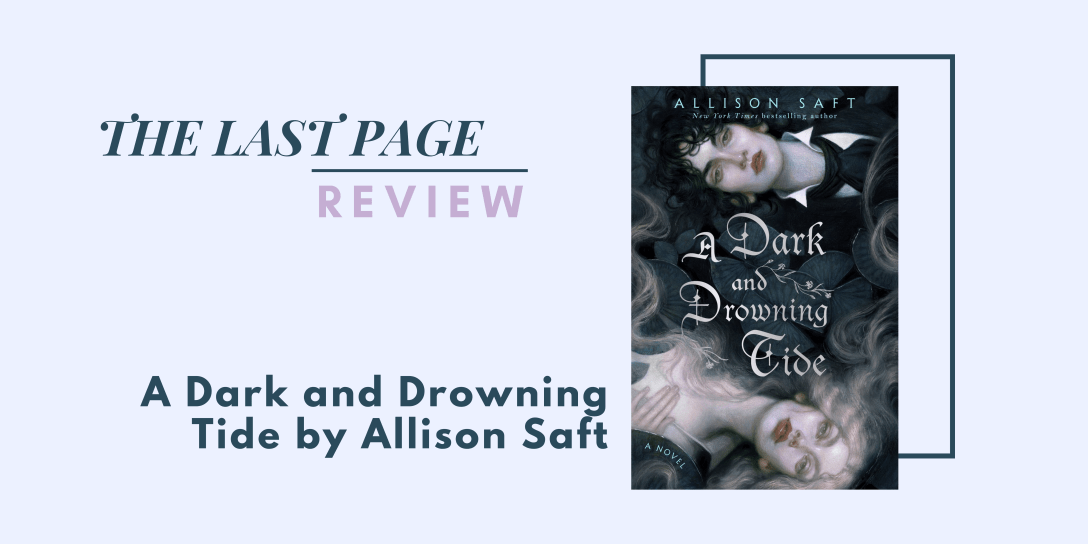
Review: A Dark and Drowning Tide by Allison Saft

Rating: 5 out of 5.

Folklorist Lorelei Kaskel has always been set apart from her peers. None more so than Sylvia von Wolff, her long-time academic adversary, whose scintillating intelligence is matched only by an arresting beauty. All Lorelei dreams of is becoming a naturalist, a profession that will open up the borders to her world and allow her to travel without restriction. But first, she will have to prove her talents on a dangerous expedition to unearth the location of the fabled Ursprung – believed to be the source of all magic and said to harbor untold power. The untested power found within its waters is coveted by Brunnestaad’s king, Wilhelm, who wishes to claim it so that he can forcibly unify his patchwork kingdom. Alongside five nobles and her fearsome mentor, Ingrid Ziegler, Lorelei embarks on an expedition never believing what is in store is the murder of her mentor on their first night on board. Trapped with five other people with competing motivations, one of whom is the murderer, Lorelei faces the likelihood that the violence has not been curbed. Finding their way to the spring has become more pertinent, but Lorelei will have to rely on the only person she knows is innocent, her bitter rival, to make it there. Unburying the truth and discovering a spring known only in myth is enough of a challenge, without bruised hearts and unkindled longing setting them even more adrift.

A Dark and Drowning Tide is an elegantly fashioned fantasy novel that delves deep into the heart of folktales and their origin, as two women in academia fight for their place in the world and what they mean to one another. In her adult debut, Allison Saft serves up a fantasy adventure with a slice of academic rivalry that is both endearing and ardently romantic. Part romantic adventure, but centered strongly around a murder plot, A Dark and Drowning Tide brings a lot into focus but expertly uncovers what lies beneath its mirrored surface. As a longtime reader and admirer of Saft’s writing, there was little doubt in my mind that the yearning in this novel would be excruciating and the prose sublime. Since reading her young adult debut back in the pandemic, Saft has leveled up her craft tremendously and that is no more evident than with her foray into adult romantic fantasy. Exposing the flawed foundations of folklore and their influence, Allison Saft highlights the enduring power of connection in transforming ourselves and finding belonging, with love itself as the catalyst.

Reading A Dark and Drowning Tide was undeniably immersive like the crystalline pools our academics trek towards, holding the key to immeasurable power. As if ensorcelled by a faerie spell, Saft draws you down into dark waters and hits the mark with her mesmerizing prose and snippy back and forth between heated rivals. Stuck on an expedition with five nobles hardened by their shared experiences in childhood and war, Lorelei Kaskel is the odd one out. A Yeva in the kingdom of Brunnestaad, she is granted the status of a second-class citizen, kept inside a gated community with restrictions on travel outside of those walls. Lorelei is haunted, caught up in the grief of the murder of her brother and the feeling of sundering her Yevani identity the further she wades into academia. Trapped with only a narrow way forward, as ghosts from her past and her brother, Aaron, linger on, Lorelei adds another individual to her hauntings – Ingrid Ziegler, her mentor horrifically murdered on the night they depart on their expedition. Hardening her heart and barbed with protective thorns, Lorelei sticks to what she knows to uncover the truth about the murder, yet her rival Sylvia manages to worm her way past those defenses, and all for the better. 

Wishing to be a naturalist, Lorelei was instead handed a pen and told to document folktales. In accepting her fate as a folklorist, folktales have become their own kind of armor – something worn as a shield against the horrors of the world but also protection for her vulnerable heart. Allison Saft attaches the meaning behind every story across this novel, as Lorelei uses folktales to make sense of her world, contextualizing human behavior and her experiences along the Ruhigburg expedition. Opening up to Sylvia is in part removing the barriers that have protected her for so long, and acknowledging how they have pushed away someone who could have been a friend and ally. The romance between Lorelei and Sylvia was the slowest of slow burns for one reason and one reason only: these two are idiots. Lorelei and Sylvia were idiots to lovers first and academic rivals second and I love them all the more for it. There’s tension between their misperception of the state of their relationship that plays out rather comedically as they begrudgingly become allies. Lorelei is head too full of thoughts, none of them the right ones, and Sylvia is just unbridled longing and a desire to be seen. Dissolving these barriers is a journey in itself, as they ride across snowy plains on the back of Mara’s, go deep sea diving with Nixies, and endure only one tent trope one night after the next. Allison Saft takes her time drawing together the story these two can write side by side, but it’s one that is entirely hopeful and leaves them in control of the narrative.

In A Dark and Drowning Tide, Allison Saft harnesses folktales as a reflection of societal wounds, and the hurt and hate they reflect and in turn, spur. Lorelei is intrinsically caught up in this as a folklorist and a young Jewish woman, but she inadvertently becomes trapped by story.  Lorelei deals with having to sunder parts of herself and her faith if she ever wants to survive outside of the Yevanverte and make a name for herself as a naturalist. Caught up in grief and enduring memory, Lorelei finds power in charting her own story and honoring the memory and sacrifices of those who came before her. Her love story with Sylvia is an extension of that as they navigate a course out of an impossible situation discovering exactly how they were wrong about each other and choosing a future that they can write together. A Dark and Drowning Tide has struck a wonderful harmony with a romance between misunderstood rivals and lost souls finding respite. It’s the kind of book I want to stay wrapped up in forever. Wonderfully layered like what lies beneath some hidden well of power, Allison Saft’s talent lies in her capacity to depict intense yearning, the flaws in believing you know your enemy, and the traumas endured but ultimately survived. This is a story that will undoubtedly resonate with many, leaving behind a kernel of hope that will kindle and then spark into an inferno.

Thank you to Edelweiss and the publisher for providing the arc in exchange for an honest review.

Trigger warnings: violence, death, murder, blood, war, panic attacks, colonization, antisemitism

Buy a Copy: